
Fewer documents from home, no crypto reporting, no CRS commitment, QR payments from stablecoins and lower prices. On paper, Bolivia asks in return that you really live there. In practice it is looser.
For years Paraguay was the obvious choice for anyone looking for a plan B in South America. This year it picked up stricter conditions for permanent residency, annual crypto reporting and, in November, the fall of Ueno Bank. So we took a look at the neighbour that people looking for a plan B hardly ever mention.
Paraguay wants your paperwork, Bolivia wants you. Bolivia is easier to get into, and freer on crypto and data exchange. By the text of its rules, though, it doesn’t work from a distance: you can be out of the country for only 90 days a year, against up to a year on a Paraguayan temporary permit. In practice it is looser, as we describe below.
This is the first of two articles on Bolivia. The second describes the immigration process day by day. Figures are as of 21 November 2026 unless another date is given. We convert to dollars at the central banks’ rates of 20 and 21 November: Bs 11.75 and ₲6,407 to the dollar.
In short
- You only need your passport from home. We had the visa the same day and the cédula five days later; in Paraguay it takes months.
- According to Numbeo, everyday life is about a third cheaper than in Asunción.
- No crypto reporting, no CRS, and QR apps let you pay with stablecoins everywhere. Banks’ crypto products don’t work for foreigners yet, though.
- By the rules you can be out of the country only 90 days a year. In practice it is looser, but that isn’t a rule.
- Paraguay has a better rating, higher deposit insurance and a stronger passport.
The eight reasons
- From home, you bring only your passport
- Everyday life is cheaper
- A visa in a day, a cédula in five
- You can pay a QR code from stablecoins
- No annual crypto reporting
- Bolivia is outside CRS and has no deadline
- No monthly cap, and stablecoins instead of a dollar account
- A country where you pick your climate by altitude
And the rest
1. From home, you bring only your passport
A Paraguayan temporary permit takes an apostilled birth certificate, a criminal record extract from home, Interpol and an extract from the Paraguayan police. So the paperwork starts before you leave home.
The form from DIGEMIG, Bolivia’s immigration office, asks for an extract from your country of origin or an Interpol certificate, and you can get the Interpol one on the spot. A birth certificate isn’t on the list at all for the work or self-employed route. The copy of the form we could read dates from 2020, but the current guide from the agency Lincoln Global Partners, which sells this service, describes it the same way. DIGEMIG’s portal for foreigners opened for us on 6 November, but its list of countries and requirements did not load. The portal itself warns that the published requirements will still be adjusted under the government’s Tranca Cero programme, which since June 2026 bars state offices from asking for a birth certificate where proving identity is enough. Whether this has already changed the published requirements, we don’t know yet.
“Only a passport” is meant literally, at least if you have a determined purpose in Bolivia. Ours is work for a Bolivian company. Everything else is done in Bolivia: Interpol, a medical exam and, if you have stayed in Bolivia before, a Bolivian criminal record extract. We did not have to show any income or savings, because on the work route the form counts the documented work as proof of means too. With only a sworn statement of your activity, the form expects three months of bank statements, and in practice they tend to ask for four. It gives no amount; in practice agencies talk about roughly USD 5,000 in an account or USD 400 a month. The form says foreign-language documents must be translated and legalised, but in practice that isn’t needed for bank statements.
You will need a birth or marriage certificate if you apply through family. You enter Bolivia as a tourist, with no visa arranged in advance. That is how we entered, and we started the process on the spot, using the entry stamp that the form accepts for Group I countries. The Czech embassy says the purpose of a visa-free tourist stay cannot be changed, but that isn’t accurate. Nationals of Group I countries routinely start the process on a tourist stamp, as we did. It may be outdated information the embassy never corrected. We describe the whole process day by day in our article on the immigration process.
2. Everyday life is cheaper
This may be the most tangible advantage. According to Numbeo on 20 November, living in Santa Cruz costs 37% less than in Asunción without rent and 31% less with it. Restaurants are half the price, groceries 42% cheaper and rent 9% cheaper. La Paz comes out as much as 47% cheaper including rent.
| In USD | Santa Cruz | Asunción | Difference |
|---|---|---|---|
| Meal at an inexpensive restaurant | 2.07 | 7.15 | −71% |
| Dinner for two, mid-range restaurant | 17.16 | 39.71 | −57% |
| Cappuccino | 1.76 | 3.08 | −43% |
| Milk, 1 l | 0.76 | 1.18 | −36% |
| Bread, 500 g | 0.97 | 1.37 | −29% |
| Eggs, 12 | 1.10 | 2.22 | −51% |
| Cheese, 1 kg | 3.26 | 8.99 | −64% |
| Chicken fillets, 1 kg | 2.67 | 4.83 | −45% |
| Beef, 1 kg | 5.08 | 9.25 | −45% |
| Tomatoes, 1 kg | 0.77 | 2.29 | −67% |
| Petrol, 1 l | 0.60 | 1.15 | −48% |
| Local transport ticket | 0.26 | 0.54 | −52% |
| Utilities, 85 m² flat, monthly | 35.96 | 46.22 | −22% |
| Internet 60 Mbps+, monthly | 17.94 | 22.13 | −19% |
| Mobile plan with 10 GB+ | 17.92 | 15.05 | +19% |
| Gym, monthly | 17.92 | 33.75 | −47% |
| Men’s haircut | 5.15 | 14.30 | −64% |
| Rent, 1-bedroom flat in the centre | 267 | 579 | −54% |
| Rent, 1-bedroom flat outside the centre | 247 | 350 | −30% |
| Rent, 3-bedroom flat outside the centre | 842 | 592 | +42% |
| Buying a flat, per m², centre | 1,296 | 1,748 | −26% |
| Buying a flat, per m², outside the centre | 741 | 1,230 | −40% |
It matches our own receipts. We got the five-star Swissôtel in Santa Cruz with breakfast for about USD 37 a night through the Bolivian agency Estropical, a haircut cost Bs 40, about USD 3.40, and 15 days of unlimited mobile data cost Bs 50.
Property is a more mixed picture. Small flats are much cheaper in Santa Cruz, but according to Numbeo larger flats outside the centre cost more than in Asunción. Buying is a quarter to 40% cheaper, though flats in Equipetrol, Santa Cruz’s most sought-after district, are listed at roughly USD 1,300 to 2,750 per m² depending on age and condition, above the average. And foreigners can’t buy within 50 km of the border.
Not everything is cheaper. According to Numbeo a mobile plan with calls costs more, although prepaid data is cheap. Imported goods such as branded jeans or shoes cost about the same or more, and an international primary school in Santa Cruz runs to about USD 9,100 a year, against 5,600 in Asunción.
Much of the gap comes from the fall of the boliviano from 6.96 to 11.75 to the dollar. Prices are gradually catching up, with inflation at 7.1% year on year in October, so the advantage may shrink. Numbeo also rests on a small sample: 28 people contributed in Santa Cruz over the past year and 39 in Asunción. Treat it as a November snapshot, not statistics.
3. A visa in a day, a cédula in five
In Bolivia we had a three-year visa in the passport on the same day we applied. At five in the morning we were queuing outside the immigration office in Santa Cruz, and at half past ten we left with the visa. Around noon the same day we applied for the foreigner’s cédula, and it was ready five days later. We describe the whole procedure in our article on the immigration process.
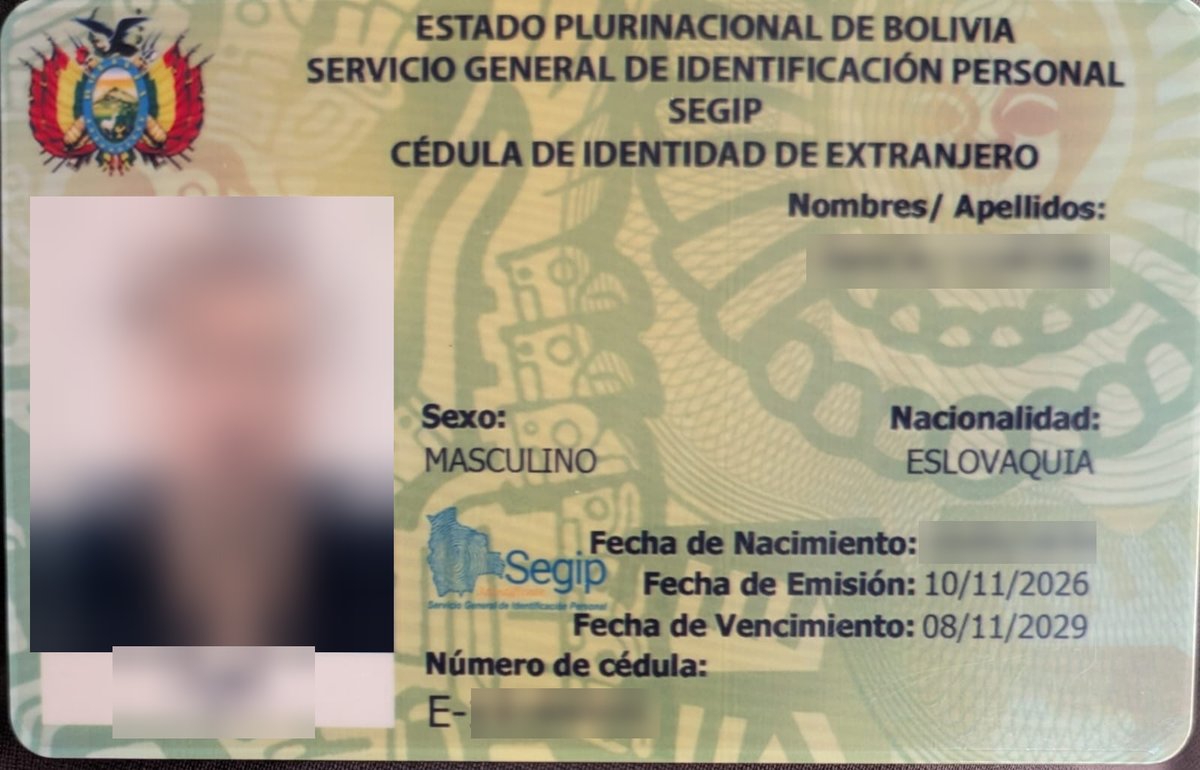
It isn’t always this fast. The office can keep your passport for the whole processing period, and with complete documents it currently takes roughly eight business days, according to agencies. When the file goes to La Paz, it can take three weeks. So don’t book onward travel right after you apply.
In Paraguay the temporary permit alone takes four to eight weeks, according to the agencies that handle it. Only then does the police issue the cédula, and its official reference time is 60 to 90 business days, another three to four months.
4. You can pay a QR code from stablecoins
In a sense, Bolivia has 100% crypto adoption. Not because everyone holds crypto, but because you can pay with stablecoins practically everywhere. Apps such as Takenos made this possible by linking stablecoin balances to Bolivian QR codes. Each of those codes belongs to an ordinary bank account of the merchant, so you can pay it even if the merchant knows nothing about crypto.
And almost everyone in Bolivia has a QR code. In 2025 there were 891 million QR payments, or 28 a second. 3.7 million people and 1.5 million merchants use it, and in Cochabamba even the woman selling corn at the market has one. You see the amount in bolivianos, the app deducts dollars from your stablecoin balance and the merchant receives bolivianos in their account.
- Takenos pays any interoperable QR with no commission, but with an exchange-rate spread. Anyone can pay; a Bolivian ID is only needed to deposit bolivianos. It isn’t on the Slovak or Czech App Store, though it is on Google Play.
- Wallbit is expressly open to foreigners, at 1% according to its own website.
- Airtm pays from USDC, up to USD 10,000 a month.
- Meru has Bolivia QR with no deposit or withdrawal fee, and doesn’t state its spread.
- El Dorado and Bitget Wallet also support Bolivian QR, Bitget as a self-custody wallet.
- Binance Pay has paid Bolivian QR codes since April 2026, but according to Binance only for accounts verified in Bolivia, and Belo doesn’t accept Slovak or Czech IDs.
- Bybit Pay has paid Bolivian Yape QR codes since March 2026.
In Paraguay we found no app that pays the local QR from a stablecoin today. Takenos lists it only as a future market, even though the QR system itself is strong there, with 25 million payments in August.
We use Takenos ourselves, and it works with both a Paraguayan and a Bolivian cédula. We pay with it by QR code all over Bolivia, and with a Bolivian cédula you can also top it up in bolivianos. For the other apps we rely on their documentation, and we haven’t tested any of this with a European passport. “No commission” also doesn’t mean free: on 6 November Takenos gave about Bs 11.80 to the dollar against the official 11.89. Takenos doesn’t have its final licence from the regulator ASFI yet and you are keeping money with an intermediary, so treat it as spending money, not savings. The exchange-rate advantage that got all this started disappeared with the floating rate of June 2026. And carry cash: according to the central bank, it still makes up 64% of household consumption. Paying directly in USDT is more of an exception, for example for cars at the dealers Toyosa and Crown.
5. No annual crypto reporting
Since this year Paraguay has had DNIT General Resolution 47/2026. If you are resident and your transactions through foreign platforms or without an intermediary, which includes your own wallet, exceed USD 5,000 in a year, you report them to the tax office once a year. You also report your holdings, hashes and addresses. The first filing is due in March 2027, and the late penalty is ₲1,000,000. This is not a tax on worldwide income, since Paraguay only taxes Paraguayan-source income. But the head of the tax office says openly that he wants to compare the data with people’s wealth and look for undeclared income.
We found nothing like it in Bolivia. Resolution 19/2025 of the UIF, the financial intelligence unit, expressly excludes people who buy virtual assets for themselves, for payments or for private investment. Decree 5384 puts no duty on ordinary users, and none of the tax office’s 44 resolutions this year has crypto in its title.
That doesn’t mean crypto is tax-exempt in Bolivia. The tax office simply hasn’t taken a position yet. The country only taxes Bolivian-source income, but that includes work physically carried out in Bolivia, whoever pays for it. Banks also report crypto transactions to the UIF every month, and in its IMF programme the government committed to preparing a regulatory framework for virtual assets, whose scope nobody knows yet.
The tax on large fortunes, on the other hand, applies to anyone who spends more than 183 days in the country within 12 months and has net wealth above Bs 30 million. It counts assets abroad and “any other tangible or intangible thing of economic value”, which very probably includes crypto. After the fall of the boliviano that threshold is only about USD 2.55 million, not the often-quoted USD 4.3 million. The rate is 1.4 to 2.4% a year. The government wanted to repeal it, but a committee of the lower house rejected that in February, and we found no report of a later repeal. How it is enforced, we don’t know. Anyone with that kind of wealth should talk to a Bolivian tax adviser before moving.
6. Bolivia is outside CRS and has no deadline
Bolivia does not appear on the list of CRS signatories of 30 October 2026, the list of commitments of 30 September or among the countries exchanging data. It hasn’t signed the multilateral convention either, and the OECD calls its network of information-exchange agreements “muy limitada”. Paraguay has voluntarily committed to a first exchange by 2028, although it hasn’t signed the CRS agreement yet either.
Saying that Bolivia isn’t planning CRS would go too far. In June 2025 the OECD announced it as the 172nd member of the Global Forum, with a commitment to implement CRS, and in October it withdrew the announcement without explanation. In this year’s OECD report, the head of the Bolivian tax office writes about “concrete measures” to join in on tax transparency, with no step and no date. The accurate wording is “no commitment, no deadline”, and that can change.
Bolivia is, however, on the FATF grey list and, since January, on the EU list of high-risk countries. Expect European banks to scrutinise transfers to and from Bolivia more closely.
CRS also only decides who tells your tax office about an account, not what you owe. If you are a tax resident back home, you have to declare your income there wherever the account sits.
7. No monthly cap, and stablecoins instead of a dollar account
A foreigner without local income in Paraguay mostly ends up on a basic account. That account is in guaraníes only, with deposits of up to three minimum wages a month, today ₲9,132,000, which is about USD 1,425. GNB has the same rule. In our experience with clients, a dollar account depends on provable income, although we didn’t find this in the banks’ published terms.
We found no such cap in Bolivia. BancoSol’s tariff sheet literally says “Sin Límite” for savings. Officially, though, a Bolivian bank won’t open a dollar account for you. What it offers instead is an account in the stablecoins USDT and USDC, which is in effect a dollar account too. For a foreigner it is custody at best for now, as we describe under What about stablecoins at banks? Banks also set their own conditions, and at the end of October El Deber wrote about clients whose dollar banknotes were refused.
The limits start on the way out. The regulator ASFI set a minimum of USD 500 a month for debit cards abroad, and BNB, Ganadero, Económico and BancoSol list it as the ceiling in their tariff sheets. Old dollar balances are being released in stages until August 2027. A transfer abroad costs the greater of USD 55 or 3%, and Bisa says of its Transfer Direct service that it processes requests subject to available funds. The central bank promises that dollar “corralitos” won’t happen again. So far that is a promise, not a rule.
8. A country where you pick your climate by altitude
Paraguay’s highest point is 842 metres, Bolivia’s is 6,542. Between them lie the world’s largest salt flat, Lake Titicaca, the Amazon lowlands and colonial Sucre. In La Paz people commute by cable car, currently the longest urban network in the world with 10 lines and 30.6 km.
You can choose your temperature as well. Cochabamba averages 17.2 °C over the year and Sucre 15 °C, while Asunción averages 23 °C, with average highs of 34 °C in its hottest month. That only holds for the highlands at 2,500 to 3,650 metres, where you need time to adjust to the air and winter nights drop to around 2 °C. Santa Cruz, at an average of 24.8 °C, is warmer than Asunción.
We wouldn’t normally put a reason like this in a comparison of residencies. But by the rules you really have to live in Bolivia, so where that is matters more than usual.
What about stablecoins at banks?
Bolivia’s central bank lifted the ban in June 2024, and on paper six banks now offer a stablecoin product: Bisa, BCP, Ganadero, FIE, BNB and Unión. We couldn’t count it among the advantages of residency, though, because it doesn’t work for foreigners yet.
In November we opened accounts with our foreigner’s cédula at Banco Mercantil Santa Cruz, Banco Bisa, BCP and Banco FIE. At both Mercantil and FIE we were told that USDT, USDC and other crypto don’t work for foreigners. At Bisa you can buy USDT with bolivianos and hold it, but you can’t send or receive it, and practitioners report the same at Banco Ganadero. For a foreigner, then, it’s custody only. At BCP it doesn’t work at all for now: you have to wait three months, and even then it probably won’t work for foreigners. BCP’s same-day transfer abroad may be the only bank route out. For a foreigner, the real way into crypto is neobanks such as Meru, Takenos or El Dorado and the QR apps in reason 4. Ganadero and FIE also tie the product to Bolivian nationality on their websites. The regulation isn’t settled either: in July the president of the central bank said that the liberalisation was not a good decision and that the issue is still being studied.
For an ordinary account in bolivianos your foreigner’s cédula is enough, for example at BancoSol or Banco Unión. BCP also wants a copy of your passport, and Banco Económico may want the NIT tax number for a current account, depending on the circumstances. In practice, though, BCP and Mercantil also asked us for two local references and details of our income and work in Bolivia. Banco Ganadero, on the other hand, asked for no employment contract and no proof of income, so that is where an account is easiest to open.
What about the fall of Ueno Bank?
It might look like another reason, but the comparison with Bolivia doesn’t hold up. Paraguay’s central bank put Ueno into resolution on 2 November for insufficient solvency. The bank held about 9% of the country’s deposits, and the guarantee is ₲228.3 million per person. According to Infobae, even dollar deposits are being paid out in guaraníes. The payout was quick, though. By mid-November more than 1.8 million depositors had received money from the guarantee fund, 1.5 million of them their entire deposit. Those still waiting are mainly people with deposits above the guarantee limit, and the government promises they will get everything.
Bolivia had its own Ueno three and a half years ago. Banco Fassil, the fourth-largest bank with about 8.5% of deposits, fell in April 2023, and dollar deposits were returned in bolivianos at 6.96. Anyone who has held those bolivianos until today has lost about 41% in dollar terms at today’s rate of 11.75. Before these failures, both countries went almost equally long without a bank collapse, 23 and 24 years, and both went through a series of collapses in the 1990s (Bolivia, Paraguay).
Today’s numbers favour Paraguay, if anything. It has investment grade from Moody’s and S&P, while Bolivia is in the CCC band. Deposit insurance in Paraguay covers about USD 35,600 and paid out quickly at Ueno; in Bolivia UFV 40,000, which is about USD 11,500, paid out in bolivianos. Bolivian banks have rationed dollar withdrawals since 2023, whereas outside Ueno we found nothing like that in Paraguay. In Bolivia’s favour, 99.7% of loans are in bolivianos, so banks aren’t exposed to dollar loans, but that is because the dollar system has already collapsed once.
So neither country is a place for your savings. Think of it as an account for everyday life.
The biggest downside: on paper, you really have to live there
You won’t get permanent residency in Bolivia unless you actually live there. Under Decree 4828, the immigration office cancels a temporary permit if you are out of the country without authorisation for more than 90 calendar days in a year, in one stretch or in parts. This applies to one-, two- and three-year permits alike, and such an absence interrupts your stay. Law 370 allows an exception for a serious health reason, study or force majeure. In practice, business reasons are accepted too with prior authorisation, and according to agencies the absence can be extended to up to 180 days. Without permission, that means at least 275 days a year in the country, not “most of the time”. Paraguay tolerates a year on a temporary permit and three years on a permanent one.
Retirees can apply under the rentista category, meant for people with a regular income such as a pension. You can apply for permanent residency after three years and for citizenship after three years of uninterrupted residence, documented by your border-crossing record. Processing a citizenship application after the switch to permanent residency currently takes about eight months, though that may be quite different three years from now. Only permanent residency relaxes the regime: the limit becomes two continuous years outside the country, and you renew the foreigner’s cédula once every five years. That is paper residency by the rules, and you only reach it after three years of actually living there.
In practice, several sources say it works differently. Nothing happens automatically while you’re abroad: the permit and the cédula stay on record until they expire or until you next deal with the immigration office. In the meantime the cédula and everything linked to it, your driving licence and bank accounts, keep working. When you come back after more than 90 days, you’re told at the border that you’ve been away too long and asked to cancel the permit yourself and file a new application, which is effectively a new visa. Practitioners report no fine, entry ban or record for this, and say it can be repeated. This describes reported practice, not a confirmed rule or a recommendation. The decree still says the office “cancelará”, will cancel, the permit. Anyone who relies on this risks the practice changing, or the office not applying it in their case.
Formally, then, this isn’t a renewal, since a renewal requires a valid permit. It is a new application, each time with the doctor, Interpol, police, proof of income and the fee. The form does anticipate that a holder of a three-year permit who doesn’t want permanent residency starts a new temporary permit, so a three-year restart in itself is no invention. According to IMI Daily and the agencies, though, a three-year permit is only granted with proof of real activity in Bolivia, and a foreign company alone isn’t enough.
And what about the documents that depend on the permit?
- Foreigner’s cédula. It is valid only as long as the permit and can’t be renewed without a valid permit. According to practitioners, it stays active while you’re abroad. The fine of Bs 10 a day is for not collecting your cédula in time after you get the visa, not for time abroad.
- Driving licence. According to unofficial sources, it is valid as long as the cédula.
- Bank account. We found no rule, but in practice accounts keep working while you’re abroad, as long as the cédula is valid. After it expires, don’t count on that.
- Tax residency. The only explicit test we found is 183 days for the wealth tax. The tax residency certificate serves double-taxation treaty purposes. The rule says a foreigner attaches a record of entry dates, but in practice you can generate it by logging in to the tax office’s system about two days after getting your NIT tax number, with no day count applied. Whether your home country accepts it is up to that country. Don’t base your exit from your home tax system on it without a Bolivian tax adviser.
What else to weigh
- The state. A state of exception is formally still in force; in September parliament extended it by 90 days, into December. We didn’t notice it in everyday life, and everything works. The boliviano has fallen from 6.96 to 11.75 to the dollar, and the central bank expects GDP to shrink by 3.4%. The direction is improving: an IMF programme, better ratings and inflation that has fallen from over 20% a year ago to 7.1% in October.
- Safety. Santa Cruz, where most foreigners head, saw a wave of murders linked to Brazilian gangs, and targeted killings continued into September and October 2026. Overall, though, violence is down: police in Santa Cruz department recorded 104 complaints of crimes against life from January to July 2026, against 320 in the same period of 2025, two thirds fewer (preliminary figures).
- Health. 1.28 doctors per 1,000 people, against 3.89 in Paraguay. British diplomats also recommend insurance with air evacuation. Get vaccinated against yellow fever, since Santa Cruz is in the recommended zone.
- Property. Article 262 of the Constitution bars foreigners from acquiring property within 50 km of the border, on pain of forfeiture without compensation. A cottage on the shore of Lake Titicaca is therefore probably out.
- Fuel. Since a partial removal of subsidies in January 2026, petrol has cost Bs 6.96 a litre. Queues at the pumps still came back now and then in September; in November we didn’t run into any.
- Passport. Bolivia’s ranks 67th and Paraguay’s 30th, and it needs a visa for Schengen. A Slovak who acquires a foreign citizenship also keeps Slovak citizenship only after five years of actual residence in that state (§ 9(18) of the Slovak Citizenship Act).
Side by side
| Bolivia | Paraguay | |
|---|---|---|
| Birth certificate and criminal record extract from home | no (work route, Interpol instead of the extract) | yes |
| Processing time | visa the same day to 3 weeks, cédula in 5 days | permit in 4 to 8 weeks, cédula in 60 to 90 business days |
| Permitted absence, temporary permit | 90 days a year, more with permission | up to 1 year |
| Permitted absence, permanent permit | 2 continuous years | under 3 years |
| Crypto reporting by individuals | none found | yes, above USD 5,000 a year |
| Wealth tax on residents | above Bs 30 million, worldwide | no |
| CRS | no commitment, no deadline | first exchange by 2028 |
| FATF | grey list | not listed |
| Monthly deposit cap | none found | 3 minimum wages on a basic account |
| Dollar account | officially none: a USDT/USDC account instead, for foreigners custody only for now | in our experience, with proof of income |
| QR from a stablecoin | yes, several apps | none found |
| Cost of living incl. rent (Numbeo, 20 Nov 2026) | Santa Cruz 31% lower | Asunción |
| Rating (Moody’s / S&P) | Caa2 / CCC+ | Baa3 / BBB- |
| Deposit insurance | about USD 11,500 | about USD 35,600 |
So who is this for?
Bolivia makes sense if you really want to move to South America, live off stablecoins or foreign income, and don’t mind a country still recovering from a currency crisis. You get less bureaucracy and a faster process on the way in, less reporting, lower prices and mountains.
If you are looking for a plan B you visit once in a while, Paraguay is still the safer bet by the rules, paperwork included. In practice it works in Bolivia too, but it rests on custom, not on the rules. What the Bolivian immigration process looks like step by step is in our article on the immigration process.
The purpose of your stay can also be work for your own Bolivian company, an SRL (the local form of a limited liability company). One company can employ several residency applicants, so friends who do business together in Bolivia need only one. The company must have a real activity, even a small one, and every applicant must actually work for it. This holds for your own company and for one you already work for. A company that exists only on paper is not enough. A working company also has bookkeeping and monthly tax filings in Bolivia, an ongoing local cost.
We offer the three-year residency as a package for EUR 3,990, together with help on the spot with a bank account and a mobile line, registration for the NIT tax number and a Bolivian driver’s licence. When you order, you choose the purpose of your stay, one of three: a freelance or employment contract already in place with an existing Bolivian company, which you name; a genuine local activity, meaning your own company, which we form for EUR 2,000 more (EUR 5,990 in total); or a pension, documented with proof of the pension income. When friends share a company, the first of them chooses their own company and the others choose the contract option, name that company and save the EUR 2,000. The company’s ongoing bookkeeping is not included. You can order the package here. If the residency is refused, we refund everything you paid us as long as three things hold: you passed the background checks (the Interpol certificate and a clean Bolivian criminal record extract); you gave us every document needed, 100% correct; and, for work, the company is in good standing and shows real activity, or, for a pension, the pension income is documented.
This article is for information only and is not legal or tax advice. Rules and conditions change quickly in both countries, especially around Ueno Bank and dollar accounts in Bolivia.