
Temporary residence in Santa Cruz, described day by day. Day one: a Bolivian phone number, getting around, and four stops across the city to collect documents for the immigration office. Day two: queuing from 5 a.m., a visa in the passport and the cédula application. Day three: collecting the cédula and opening bank accounts.
In my article on why Bolivian residency can be a better choice than Paraguayan, I promised to describe the immigration process itself. I’m going through it right now in Santa Cruz, so I’m writing as I go. I have three days behind me. The first went into preparing documents, the second into the immigration office, and the third into the cédula and the banks.
Good news up front: you don’t need anything from home except your passport. Both the Interpol certificate and the Bolivian criminal record certificate are issued right here in Bolivia.
Enter Bolivia as a tourist. You don’t need any other visa in advance. Slovaks and Czechs arrive visa-free and get a tourist entry stamp at the border. That stamp is where the immigration process starts, because the official RM-12 sheet lists it as the entry document for group I countries on a first application. That’s how I entered both times.
Apply with the passport you entered on. If you might want Bolivian citizenship one day, use the passport of the country where you were born from the start.
Don’t book onward travel right away. My visa went into my passport the same day, but the office can keep your passport for the whole processing period. With complete documents it currently takes roughly 8 business days, and up to three weeks when the file goes to La Paz. It varies a lot.
First, a Bolivian number
Without a Bolivian number you can’t sign up for most local apps, including the Yango taxi service. Foreign numbers also often don’t receive verification codes, so Yango and the QR apps may not work with them. Get a SIM card on day one. You can get one for free almost anywhere. I recommend Tigo.
The line has to be registered to your passport, together with your phone’s IMEI. According to Tigo, foreigners do this at a Tigo store. A phone that isn’t registered within 72 hours of the SIM first picking up a signal is automatically blocked for calls, SMS and data (Tigo help center). To find your IMEI, dial *#06# on your phone.
If you’d rather not have your phone’s IMEI end up in a Bolivian registry, bring an old phone and put the Bolivian SIM in that one.
Then buy data. For 50 bolivianos, about €3.80, you get 15 days of unlimited data, of which up to 2 GB can be shared over a hotspot (Tigo, Paquetigos; converted at the official BCB rate of 9 Nov 2026, 13.16 Bs per euro). That will be plenty. Once the SIM works, you can get Yango and other Bolivian apps running.
Getting around
Uber works in Santa Cruz, but the Yango app is more popular: App Store Google Play
inDrive works too, and there you can negotiate the fare: you propose an amount, and drivers accept it or offer a different one. Unfortunately, the app doesn’t support my Google Pixel 10 Pro Fold.
Where to stay
When I came back to Santa Cruz to collect my cédula and sort out the banks, I stayed at the Swissôtel Santa Cruz de la Sierra. In my view it’s the most luxurious hotel in Santa Cruz. I found the best price on the Bolivian site Estropical, far lower than on Travala, for example.
Day 1: four stops
Around eight in the morning, my agent picked me up at the hotel in a taxi. Fair warning: some cars in Bolivia are in catastrophic shape, but they still run 🙂
1. Clinic: medical exam
You can’t start the immigration process without a medical exam. At the clinic they take a blood sample and measure your blood pressure. You get the results in the afternoon.
What the rules say
The DIGEMIG requirements sheet (RM-12) lists it as item 8: a medical certificate from the competent institution, or proof that you have applied for one (RM-12).
2. Interpol: records certificate
Next you go to Interpol and request a certificate from their records (certificado de antecedentes internacionales). The immigration office requires this one too. You ask for it in a short written petition, which my agent prepared and a lawyer also signed.
What the rules say
For a first application, RM-12 asks for a criminal record certificate from your home country or an Interpol certificate. If you get the Interpol certificate locally, you don’t need one from home.
3. Proof of purpose
You also need to prove a determined purpose in Bolivia, and the length of the residence depends on it. Mine is work for a Bolivian company, and I got three years.
What the rules say
The law provides for temporary residence of one year (renewable twice), two years (renewable once, for one year) and three years (Law 370, Art. 30). According to RM-12, the length depends on how long the activity you prove in Bolivia lasts. Employment and self-employment each have their own supporting documents; self-employed applicants file only a sworn statement about their activity (RM-12).
According to IMI Daily, the three-year residence is issued straight away if you work for a Bolivian company or have proof of a pension. That a sworn statement gets you only one year comes from commercial guides. The sheet itself doesn’t state a specific length.
4. REJAP: Bolivian criminal record
If you’ve been to Bolivia before (as I had), you also need to request the Bolivian criminal record certificate, called REJAP.
What the rules say
For a first application, RM-12 asks for REJAP from anyone who previously spent six months or more in Bolivia under a different residence status.
I had previously spent two months here as a tourist and still needed REJAP, even though the 2020 sheet talks about six months.
With that, you have everything ready for the immigration procedure, which starts on day two.
Day 2: the immigration office from 5 a.m.
On day two you file your application, and if all your documents are in order, you leave with a visa in your passport. You go to the immigration office in Santa Cruz (Dirección Distrital de Migración, Calle Quijarro, corner of Calle Sucre), and unfortunately you have to be there very early.
1. 5:00: the queue outside the office
You need to be standing outside the office at exactly 5:00 a.m. At 5:15 the guards come and write down who is in the queue. Anyone who isn’t in the queue at that moment won’t get into the office that day.
Bring all the documents from day one. My folder held these:
- passport, a copy of its data page and a copy of the page with the Bolivian entry stamp,
- two 4 × 4 cm photos,
- medical certificate from CENETROP (Centro Nacional de Enfermedades Tropicales) marked “válido para trámite migratorio”,
- Interpol certificate with photo and thumbprint, valid for 90 days,
- REJAP issued for proceedings before the Dirección General de Migración, valid for one year,
- proof of a determined purpose in Bolivia (in my case, work for a Bolivian company) and the documents that go with it,
- sworn statement of current address (formulario de declaración jurada de domicilio actual), filled in online on the Ministerio de Gobierno website,
- a handwritten form with your personal details, address, contact person and employer details.
The forms were prepared for me on the spot.
2. 3rd floor: filing the application
Agents aren’t allowed into the office, but whoever helps you will tell you to go to the 3rd floor and which desk to go to. Mine was desk 12. That’s where you hand in all your documents.
3. Payment order
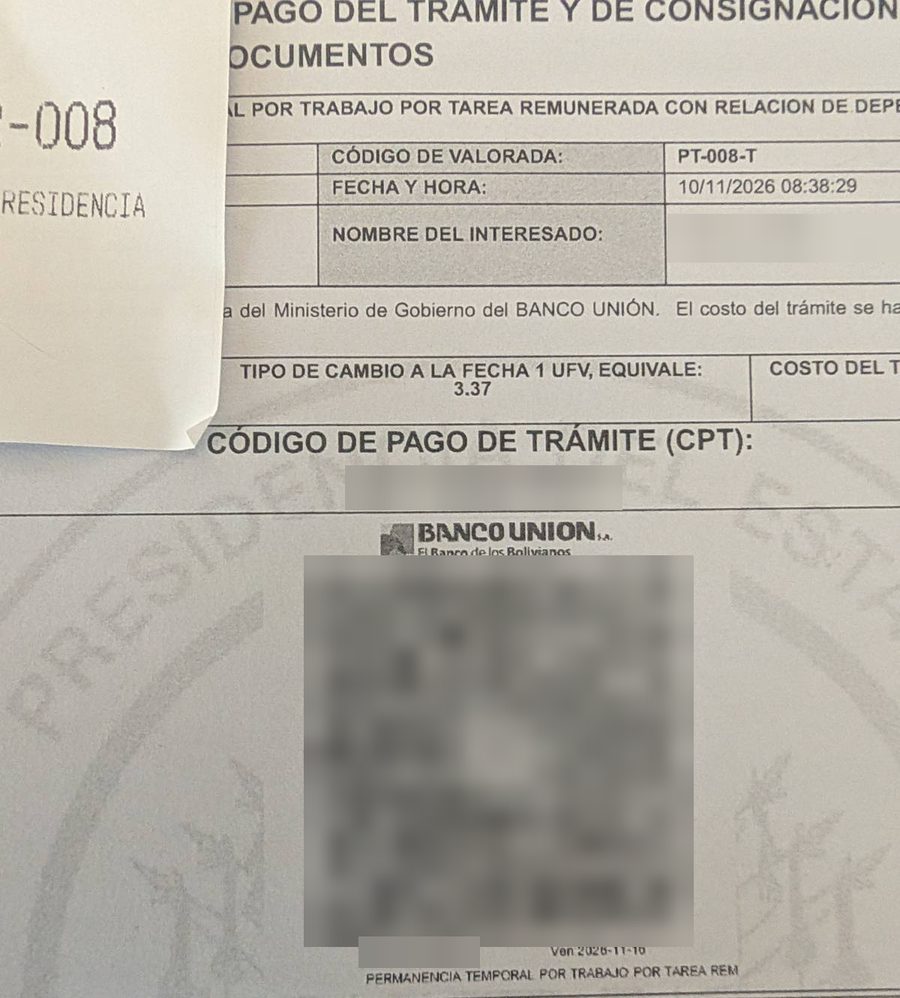
Once you’ve handed in all the documents, they issue a payment order for the fee, with a payment code (CPT) and a Banco Unión QR code. Mine was issued at 8:38. The agent pays the fee for you.
4. Visa in the passport
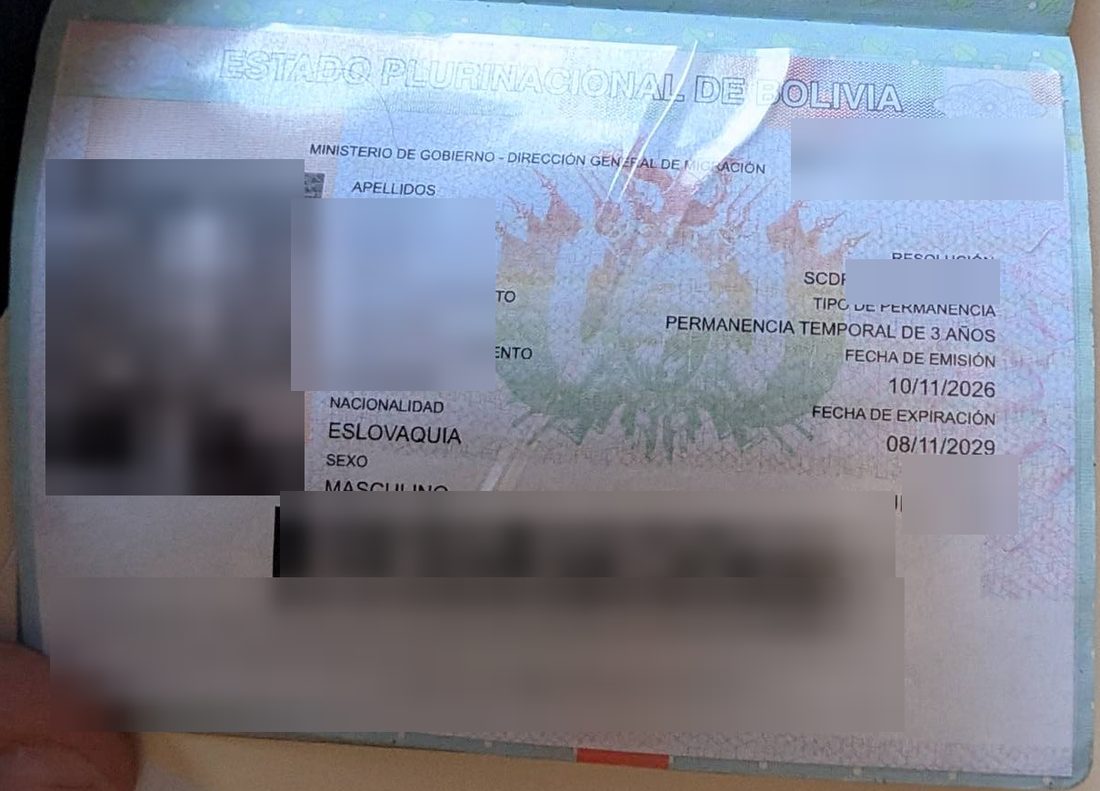
After payment, they stick the visa in your passport. Mine says temporary residence for three years (permanencia temporal de 3 años), issued 10 Nov 2026 and valid until 8 Nov 2029. Once you have the visa, you’re done at the office and can leave. I left at 10:30, five and a half hours after joining the queue.
5. Ciudad Indana: applying for the cédula
With the visa in your passport, you still need to apply for the cédula, the Bolivian ID card for foreigners (cédula de identidad de extranjero). Your agent books the appointment. Mine was the same day at 12:15, and I applied right away. You apply at the Ciudad Indana shopping mall (Indana Mall, 3rd ring road, Av. Roque Aguilera between Av. Piraí and Radial 19). You bring the visa, they take your fingerprints, and you give further details such as your address.
The cédula is printed in La Paz, so delivery to Santa Cruz takes about 5 days. If you’re physically in La Paz, you can apply for it right there.
I spent the following week in Tarija, so I only collected my cédula on 19 Nov. How that went is in Day 3.
Day 3: the cédula and bank accounts
Once you have the cédula, you can open a bank account. I did the banks on the same day I collected it.
1. SEGIP: collecting the cédula
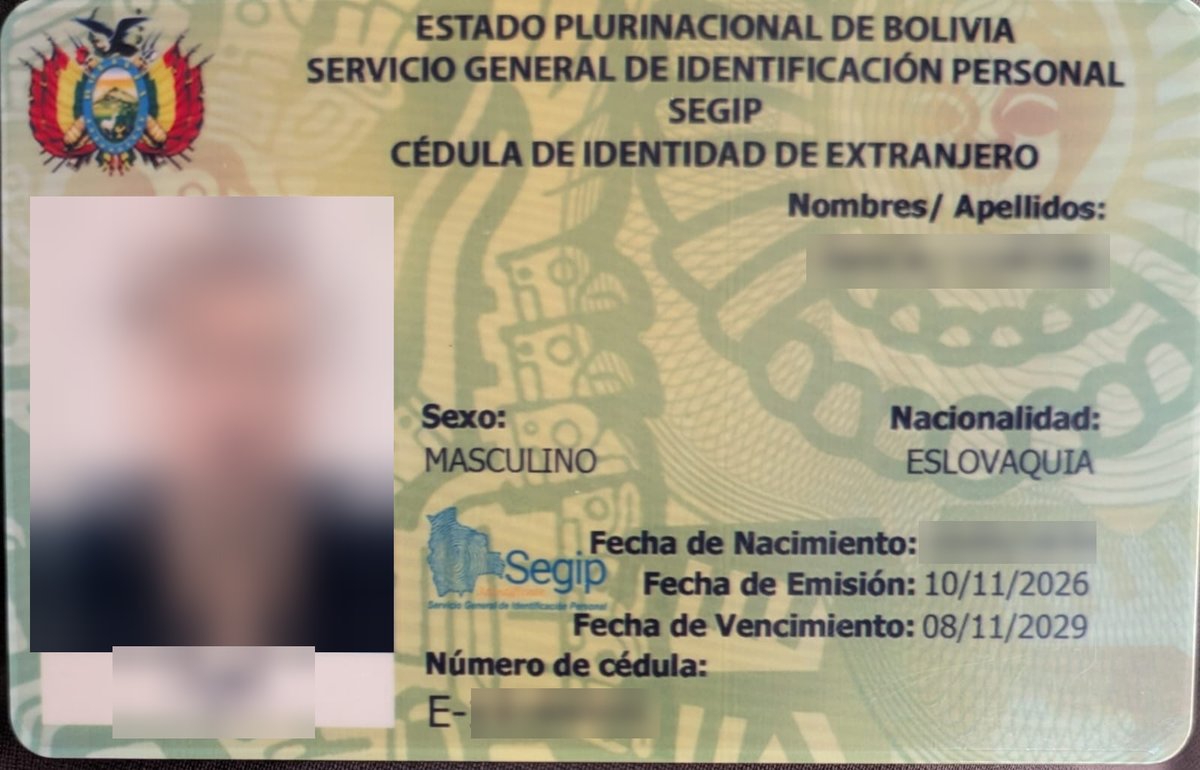
The cédula is issued by SEGIP (Servicio General de Identificación Personal). I collected it at the same office in Ciudad Indana where I had applied, at desk 1. They took all my fingerprints again, and I signed a pile of papers.
2. BCP: bank account
Next I opened an account at Banco de Crédito de Bolivia (BCP). The bank asked for:
- two references, meaning the names and phone numbers of two people who live in Bolivia,
- details of my income and my work in Bolivia,
- prints of one finger from each hand,
- an email address and a Bolivian phone number.
Their system couldn’t find the country “Eslovaquia”. In the end, Slovakia turned up as “Slovak Republic”.
At BCP I also opened an account for the stablecoins USDT and USDC, on the spot; all it took was a photo of my cédula. I can’t use it yet, though. I have to wait three months, and I don’t think it will work for foreigners even then.
3. Banco Mercantil Santa Cruz: account
I also applied for an account at Banco Mercantil Santa Cruz. They asked for the same things as BCP, and the account was approved later.
4. Banco Bisa and Banco FIE: more accounts
I also opened accounts at Banco Bisa and Banco FIE, the FIE one on 20 Nov. I now have an account at all four banks.
Crypto at Bolivian banks doesn’t work for foreigners yet. At both Mercantil and FIE I was told that USDT, USDC and other crypto aren’t available to foreigners. At Bisa you can buy USDT with bolivianos and hold it, but you can’t send or receive it. At BCP it doesn’t work at all for now.
What the office wants according to RM-12
The ten items on the official list for temporary residence for work, and where you get each one. From home, I needed only my passport.
- Application form, which also serves as a sworn statement (day 2)
- Valid passport (from home)
- Tourist entry stamp. You have to arrive in Bolivia as a tourist; Slovaks and Czechs don’t need a visa (airport)
- Yellow fever vaccination, only if you’re going to high-risk areas (depends on travel)
- Proof of activity, in my case work for a Bolivian company (day 1)
- Criminal record certificate: Interpol instead of one from home, plus REJAP if you’ve been to Bolivia before (day 1)
- Proof of financial means: for work in Bolivia the proof of activity is enough; with a sworn statement, bank statements (3 months according to the sheet, 4 in practice) (day 1)
- Medical certificate (day 1, clinic)
- 4 × 4 cm photo on a white background; they asked me for two (day 2)
- Proof of fee payment (day 2, bank)
I didn’t have to prove income or savings at all, because according to the sheet proof of work in Bolivia also counts as proof of financial means. If you go the sworn-statement route, you do need the bank statements. According to a note on the sheet, documents in any language other than Spanish must be translated and properly legalized, but in practice that isn’t required for bank statements.
My folder also included the sworn statement of current address, which the 2020 sheet doesn’t mention. The list is based on a copy of the 2020 RM-12 sheet, and the official DIGEMIG website couldn’t be opened on 10 Nov 2026, so I haven’t verified a newer version. Still, the office accepted my documents and issued the visa the same day. The government plans to revise the requirements under the Tranca Cero program, so they may still change.
In my case the purpose is work for a Bolivian company. It can also be work for your own Bolivian company, an SRL (the local form of a limited liability company). One company can employ several residency applicants, so friends who do business together in Bolivia need only one. The company must have a real activity, even a small one, and every applicant must actually work for it. This holds for your own company and for one you already work for. A company that exists only on paper is not enough. A working company also has bookkeeping and monthly tax filings in Bolivia, an ongoing local cost.
We offer the three-year residency as a package for EUR 3,990, together with help on the spot with a bank account and a mobile line, registration for the NIT tax number and a Bolivian driver’s licence. When you order, you choose the purpose of your stay, one of three: a freelance or employment contract already in place with an existing Bolivian company, which you name; a genuine local activity, meaning your own company, which we form for EUR 2,000 more (EUR 5,990 in total); or a pension, documented with proof of the pension income. When friends share a company, the first of them chooses their own company and the others choose the contract option, name that company and save the EUR 2,000. The company’s ongoing bookkeeping is not included. You can order the package here. If the residency is refused, we refund everything you paid us as long as three things hold: you passed the background checks (the Interpol certificate and a clean Bolivian criminal record extract); you gave us every document needed, 100% correct; and, for work, the company is in good standing and shows real activity, or, for a pension, the pension income is documented.