
How to get three important things done in four working days in Montevideo.
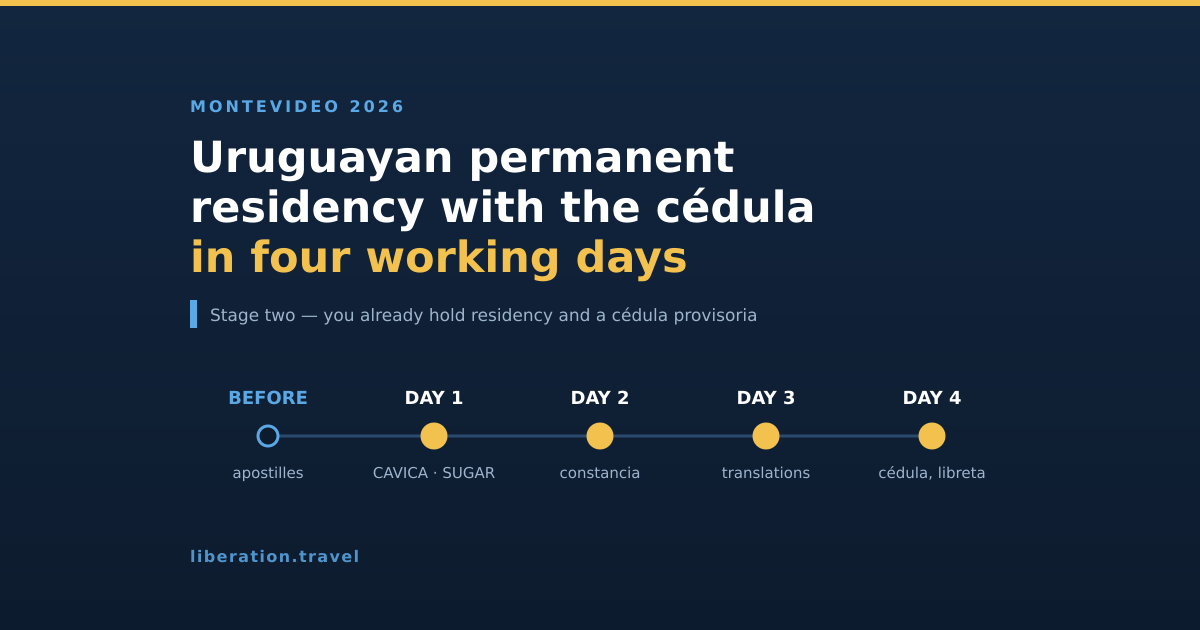
Who this is for: This is stage two. It assumes you already hold approved temporary residency and a cédula provisoria. For clients and prospective clients pursuing Uruguayan residency or citizenship who want Uruguay to become a functioning jurisdiction rather than a stamp in a passport.
In August 2026 I spent four days in Montevideo and came away with three things: a definitive Uruguayan ID card, a Uruguayan driving licence homologated from my Slovak one, and registration in the state register of cannabis buyers. Each has its traps, and I walked into at least one of each.
This is the tested guide so that you don’t.
The schedule: what to do on which day
The offices run on weekdays, so plan for four working days — start on a Monday or Tuesday, or the weekend will cut your plan in half.
Before you arrive in Montevideo
- Get the apostilles at home, always. Only the state where the document was executed can apostille it. The sworn Spanish translation also belongs at home if the original is in Slovak or Czech; if it is in a language the Uruguayan register covers, it must be made in Uruguay instead (explained below). This is the one part you cannot catch up on once you are there. If you are a Czech, Slovak or Polish client, we will obtain all of these documents for you.
- Book your online appointments: DNIC for the cédula definitiva, and the Intendencia for the driving licence homologation.
- If you can, request the constancia de domicilio online before you fly.
- Have a Uruguayan phone number and address ready. Both DNIC and the police ask for them. Nothing stops without them, but you will be improvising at the counter. Install a data eSIM before you fly as well, so that you are online from the arrivals hall — which one, and what it costs, is at the end of this guide.
Day 1
- CAVICA — the medical. No appointment, half an hour, certificate issued on the spot.
- SUGAR — hand in the translations you brought from home and have a certificado de concordancia issued for them: for the licence, and for Slovak licences with no printed expiry also for the ministry statement on validity. It takes two days, which is exactly why it has to go in on day one.
- Request the constancia de domicilio — online or at any seccional.
Day 2
- Collect the constancia de domicilio at the police station you chose, issued within 24 hours.
- SUGAR is working on the certificado de concordancia. The day is otherwise yours.
Day 3
- SUGAR — collect the certificado de concordancia.
- Intendencia, optional. If you followed this article, you do not need to come. If you do want your document chain checked, you need a separate appointment. Without the QR code from the online booking they will not let you through the door.
Day 4
- DNIC — cédula definitiva. One to two hours, while you wait. Go to the main branch (Rincón 663, Mon–Fri 07:00–17:00), the other offices close at 14:30, which does not leave you enough of a day.
- Intendencia — driving licence homologation. The Uruguayan licence is called a libreta, and it is printed in 10–15 minutes.
- Correo Uruguayo — registration in the cannabis buyers’ register. No appointment, free, on the spot.
Why this order: without the cédula definitiva the post office will not register you. The driving licence would accept a provisoria, but since you are at DNIC anyway, get it done first. And the CAVICA medical is valid for 30 days, so taking it on day one comfortably carries you to day four.
What it costs. The Uruguayan official fees are surprisingly low: UYU 443 for the cédula (886 urgente), UYU 2,591 for the driving licence homologation and UYU 800–1,500 for the medical. Roughly UYU 3,800–5,000 in total, about USD 95–125 (rate on 15 August 2026: USD 1 ≈ UYU 40.1). The digital partida, the constancia de domicilio and the registration at the post office are free (a paper partida costs UYU 153, or UYU 612 for urgent issue). What sits outside that figure are the apostilles and sworn translations you arrange at home — in practice the most expensive part of the whole exercise, and it scales with the number of documents.
1. Cédula definitiva
What you need before you start at all
A Uruguayan birth certificate (partida de nacimiento). This is the long pole and it cannot be rushed: registration in the Uruguayan civil registry itself can take one to two years. If you haven’t started it yet, we will gladly help you and get your whole Uruguayan immigration process moving.
Once the entry exists, you have two options:
- Digital partida — downloaded free online through the Solicitud de partidas trámite on gub.uy (the DGREC portal itself,
dgrec.gub.uy/partidas, is often unreachable from abroad). Enter the document type and number of the certificate holder, accept the terms, and choose whether to download it or have it emailed. A digital partida does not expire. It has the same legal force as the paper one and carries an advanced electronic signature. The 30 days you sometimes hear about are not a property of the document: they are a requirement some offices impose, asking for a partida issued within the last 30, 60 or 90 days. That is precisely why I recommend the digital version. You can pull a fresh one any time, free. - Paper partida — for older, handwritten entries. Standard issue costs UYU 153, urgent UYU 612.
Acceptance therefore depends on the office where you present it. In practice: the digital version is the safer bet, because you can pull a fresh one on the day you need it.
A valid cédula provisoria. You will hand it over. It is shredded when the new card is issued.
Booking the appointment
You will not be served without one. Book online at gub.uy, the trámite is Documento Nacional de Identidad — Renovación, or by phone on 0800 4632.
Online booking requires one of these identities: a gub.uy user account (we recommend registering), a digital cédula with a card reader, Abitab’s Identidad Digital, or Antel’s TuID. You choose the office, the day and the modality — común or urgente.
Fee (2026): UYU 443 común, UYU 886 urgente. Payment by e-banking or the BROU/Sistarbanc wallet at booking, or cash/debit at the DNIC office itself. Abitab, RedPagos and Correo add a small handling charge. You will find them practically everywhere in Uruguay.
Where to apply for the new cédula
The main DNIC office in Montevideo:
DNIC — Sede Central
Rincón 663, Ciudad Vieja, Montevideo
Monday–Friday 07:00–17:00
Tel. 2030 3700 / 2030 3704
Other Montevideo offices if the central one doesn’t suit you: Av. Belloni 2881, Avda. Gral. E. Garzón 2122 (Colón) and Somme 1567 (Hospital Pereira Rossell), all 09:15–14:30; and Géant, Av. a la Playa 99 in Carrasco, weekdays 08:15–16:30 and weekends 09:15–20:00.
How it goes
Arrive at least 15 minutes before your appointment.
An important note for clients: accompaniment is not legally permitted. We cannot come in with you and you must apply for the card exchange yourself. The good news is that the process is straightforward and manageable even with limited Spanish.
- You are given a number and wait to be called. This can take up to an hour.
- The clerk asks you, in order, for your Uruguayan address, a Uruguayan mobile number, a second Uruguayan mobile number, your email, your occupation and your marital status (single, married, divorced). Have these ready in advance. A Uruguayan address and two Uruguayan phone numbers are exactly what people freeze on at the counter.
- They photograph you, no glasses, and you sign on a tablet.
- You move to the second part of the office, where the new card is printed within half an hour.
- It is handed over against your old cédula, which is shredded, and the birth certificate.
The whole thing takes one to two hours and is done while you wait. Validity is set individually. Mine came out to March 2028, just under two years. Check the date on your own card and expect the cédula to be the first of your documents to need renewing.
2. The Uruguayan driving licence
This is considerably more complicated than Paraguay. It is worth it for the ten-year validity. That is where the real difference lies.
Uruguayan vs Paraguayan: what you actually gain
- It is valid for 10 years. That is exceptional in the region, my Paraguayan licence expired after five. For a document you renew from abroad, the difference between a five- and a ten-year cycle is enormous.
- Uruguay is a contracting party to the 1968 Vienna Convention on Road Traffic (acceded 8 April 1981), so the licence is directly recognised across dozens of contracting states. The card itself is printed with the Geneva 1949 / Vienna 1968 / Washington 1943 conventions, but that is text on the card, not a list of countries that will honour it.
- Within Mercosur it is recognised automatically. Exactly as the Paraguayan one is. There is no difference on that point.
Where it actually matters. Paraguay is not a party to the Vienna Convention. It is a party to the older 1949 Geneva Convention. The difference shows in countries that recognise only one of the two. A Uruguayan licence rests on a treaty in, for example, Germany, Brazil, Mexico, Saudi Arabia, Indonesia, Pakistan, Ukraine and Kazakhstan. A Paraguayan one does not.
To be fair, it also runs the other way. Uruguay is not a party to the Geneva Convention. In countries that recognise only that one (the United States, Canada, Japan, Australia, India, Argentina or Ireland) it is the Paraguayan licence that is covered by treaty and the Uruguayan one that is not. Neither is universally better; they complement each other. Both lists come from the UN treaty database — parties to Vienna 1968 and to Geneva 1949.
What you must bring
If you hold a foreign licence (European, Paraguayan, Panamanian) the chain looks like this:
- The original must be valid. Nothing else matters if it isn’t.
- A certificate from the authority that issued it (certificado de legalidad de la licencia expedido por la entidad emisora). It must contain at minimum the licence data, the types of vehicle it authorises you to drive, and the validity dates.
- An apostille on that certificate.
- A sworn Spanish translation and an apostille on the translation, where the translation is made depends on the source language; see the next section.
- A certificado de concordancia — see the next section.
Without the complete chain your licence will not be recognised.
In fairness, here is how it actually went for me: at the counter, my notarised and apostilled Slovak licence was accepted together with the translation, the certificado de concordancia and a translated ministerial statement on validity. Treat that as luck rather than a plan, prepare the complete chain.
Certificado de concordancia, and the Slovak problem
There is no sworn translator for Slovak in Uruguay, nor for Czech. The register of the Colegio de Traductores Públicos del Uruguay covers five languages: German, French, English, Italian and Portuguese. You can check it yourself in their directory of translators.
Where the translation is made depends on the source language (decide this before you pay for anything:
- The original is in a language the register covers (English, German, French, Italian, Portuguese)) then the translation must be made in Uruguay by a local traductor público, not at home. Send us the originals and we will arrange it.
- The original is in Slovak or Czech. The register has no such language, so have the sworn Spanish translation made at home and apostilled (both the original and the translation). In Uruguay, SUGAR then issues only the certificado de concordancia.
The solution is therefore called a certificado de concordancia: the translation is signed by a traductora pública jointly with an idónea, a person demonstrably competent in the language, and the document states explicitly that this route was taken “por no existir traductor público de idioma eslovaco en el país”. The Intendencia confirmed to me by email that “la traducción puede ser con asistencia de idóneo”.
Two days’ work, here:
SUGAR — Oficina de Traducciones
Cerrito 563, esc. 001, Montevideo 11000 (Ciudad Vieja)
Tel./fax (598 2) 915 94 47
ofisugar@gmail.com · trasugar@gmail.com
Traductora pública: Susana Rettich Brüdner
Special case: a licence with no printed expiry date
This was my situation and it deserves its own section, because it affects a large share of Slovak drivers.
Older Slovak driving licences carry no printed expiry date. Field 4B is blank. The Uruguayan Intendencia nonetheless needs to see that the document is vigente. The fix:
- Print the Slovak Ministry of the Interior statement on licence validity. The rule has two brackets and hitting the right one is critical: licences issued 1 Jan 1993 – 30 Apr 2004 (the pink laminated ones) were valid until 31 Dec 2023; those issued 1 May 2004 – 18 Jan 2013 are valid until 31 Dec 2032.
- Have that text translated at home by a sworn translator, exactly like the licence itself, and have SUGAR issue its own separate certificado de concordancia for it.
The Intendencia confirmed this explicitly. The certificate should show “sus fechas de vigencia y/o la aclaración … sobre la vigencia en Eslovaquia”. The statement therefore fully substitutes for the missing date on the card.
Check field 4A (date of issue) on your own licence before ordering anything. The difference between 30 April 2004 and 30 April 2007 is one digit, and the difference between a valid and an expired document.
The infringement record — bring it anyway
I recommend also asking your issuing authority for a record of outstanding fines and traffic offences, and apostilling it, having it translated at home and adding a certificado de concordancia as well. They did not ask me for it, but the Intendencia says they may. Ordering it from abroad after being sent home costs far more than carrying it unnecessarily.
The medical examination
No appointment needed. I recommend:
CAVICA
Av. Italia 2496 (between Avelino Miranda and Presidente Batlle), Montevideo
Monday–Friday 07:00–17:00, Saturday 08:00–12:30
Tel. 2482 5094 / 092 400 204
cavica.com.uy
CAVICA is on the Intendencia’s official list of approved medical institutions for categories A, G1 and G2. If it does not suit you, there are dozens more on that list.
Ask explicitly for the certificado médico para homologación de libreta de conducir for categories A, G1 and G2. They take your blood pressure, check vision and hearing, and run basic reflexes. It takes about half an hour, the certificate is issued on the spot, and it is valid for 30 days.
The fee runs roughly UYU 800–1,500 depending on the provider. No blood tests and no fasting — those belong to the professional categories, not to A/G1/G2.
Booking at the Intendencia
You must reserve in advance, three ways:
- WhatsApp to 099 019 500 (this is how I did it and it worked best
- phone 1950 4000, option 2) the line runs Mon–Fri 08:00–19:00 and Saturday 09:00–13:00
- the web agenda at tramites.montevideo.gub.uy/reservas-de-hora
The official description of this trámite, with the current fee, is on the Intendencia portal: Homologación de licencia de conducir categorías A, G1 y G2.
The agenda opens every day at 08:00. I booked mine about a week ahead, and slots three to four days out are usually available too, but book it before you fly to Uruguay, so your plan does not hang on whatever the agenda happens to have free.
At the Intendencia, step by step
Intendencia de Montevideo
Av. 18 de Julio 1360, Montevideo
Despacho de Conductores: 1er subsuelo, sector Santiago de Chile, puerta 33
Arrive inside the ±15-minute window you reserved. The entry window is hard and the QR code expires with it.
- Tell them you want to homologar una licencia de conducir extranjera.
- They send you one floor up to pay the fee — UYU 2,591.
- You get a numbered ticket and wait to be called.
- You show: your Uruguayan cédula (the Intendencia confirmed to me in writing that a provisoria is enough; I used my new definitiva), the apostilled licence with its apostilled Spanish translation and certificado de concordancia, optionally the infringement record, and the CAVICA medical certificate.
- That’s all. In 10–15 minutes they print your new licence while you wait.
You get your original licence back. The Intendencia does not keep the foreign licence your Uruguayan one is built from, unlike the old cédula, which DNIC shreds.
One condition people forget: you must have no unpaid Uruguayan traffic fines. The online Consulta de Infracciones works on a vehicle plate, not on a person. If you have never registered a car here, check via WhatsApp 099 019 500 beforehand rather than at the counter.
Which categories you get
Uruguayan categories do not map onto European ones, so don’t be alarmed:
- A — cars up to 9 occupants including the driver (with trailer, up to 4,000 kg). This is the car category.
- G1 — mopeds up to 50 cc without gears, and light quadricycles
- G2 — motorcycles and mopeds up to 200 cc
- G3 — motorcycles with no displacement limit
A European B therefore homologates to A. They also gave me G2, even though my Slovak AM formally covers mopeds only. The Intendencia was generous. Which is exactly why it pays to have the medical certificate issued for all three of A, G1 and G2: it costs nothing extra and blocks nothing.
3. Registering as a cannabis buyer
Uruguay was the first country in the world to fully legalise cannabis (Law 19.172 of 2013), and it runs sales through ordinary pharmacies and a state register of buyers. It is not, however, a tourist attraction — only citizens and permanent residents may register.
What you need
- A cédula definitiva. A provisoria is not enough. The requirement is Uruguayan citizenship (natural or legal) or duly accredited permanent residency. Cards printed “Residencia en trámite” are rejected by the system.
- A constancia de domicilio in your own name, no more than 3 months old.
- Age 18+.
- You must not be registered as a home grower or club member. The three registers are mutually exclusive, and switching between them carries a 3-month wait.
The constancia de domicilio
It is free and carries the weight of a sworn statement. Request it as early as you can — ideally online before you fly, otherwise on your first day.
There are two ways to get it:
- Online through the Solicitud de constancia de domicilio trámite on gub.uy, you need a gub.uy account or electronic identity (the digital cédula requires a card reader). During the request you choose the police station where you will collect it.
- In person at any Seccional Policial, 09:00–17:00.
Within 24 hours you collect it in person at your chosen seccional with your cédula. The police will ask for a Uruguayan phone number, your occupation and an address (again, have these ready) and issue the certificate. You pay nothing.
A UTE, OSE or ANTEL (fixed-line) bill in your name is also accepted. If you have none, the police route is the only one.
The registration itself
With your cédula definitiva and constancia de domicilio, walk into any participating Correo Uruguayo branch. No appointment, no cost. Documents are shown, not copied.
Important: you must give fingerprints, a minimum of 4 of 10. If you have already handed them to the corrupt Slovak or Paraguayan government, the considerably less corrupt Uruguayan one should not trouble you. (For the small percentage whose prints cannot be read, IRCCA has an alternative process — registration without fingerprints, and purchases via a TDC ticket.)
You are registered on the spot.
And you can buy straight away — I walked from the post office to the pharmacy.
How buying works afterwards
The list is here: lista de farmacias adheridas. There are currently 60 pharmacies nationwide — 26 in Montevideo, 8 in Canelones, 7 in Maldonado.
At the pharmacy you identify yourself with a fingerprint or your cédula definitiva, either is enough. The IRCCA system verifies on the spot that you are authorised and how many grams you may still buy.
It is sold in 5-gram packages (you may take 5 or 10 g at a time). Prices in force from 1 August 2026, per 5 g package:
- Alfa, UYU 500 — hybrid, indica-dominant. THC up to 9%, CBD from 3%, medium-to-low psychoactivity.
- Beta, UYU 510 — hybrid, sativa-dominant, otherwise the same: THC up to 9%, CBD from 3%, medium-to-low psychoactivity.
- Gamma, UYU 580 — THC up to 15%, CBD up to 1%, high psychoactivity.
- Épsilon, UYU 630 — THC up to 20%, CBD up to 1%, high psychoactivity.
CBD moderates the effects of THC, so what matters is the ratio rather than the THC figure alone, which is why Alfa and Beta are markedly gentler than Gamma. If you have no experience with this, start with Alfa or Beta. The flower is grown on a state site in the San José department run by IRCCA.
Cash only.
Limits: 10 grams per week, 40 grams per month and 480 grams per year. The system checks the last 7, 30 and 365 days.
You are anonymous to the pharmacy — with the fingerprint you need not give your name or show a document at all. Not to the state. You are in the IRCCA register, and the system checks your remaining allowance on every purchase.
And one thing not worth attempting: export is illegal. The Uruguayan register entitles you to buy and consume in Uruguay. Crossing a border with anything from the pharmacy is a criminal offence in the destination country, and your Uruguayan registration protects you by exactly zero grams.
The part nobody plans: getting online
Every office in this guide wants a Uruguayan phone number, and the DNIC clerk asks for two of them. That is a local SIM, and you can buy one on your passport — the original, not a copy — from Antel, Movistar or Claro. What a local SIM will not do is get you online in the arrivals hall, and data is the first thing Montevideo asks of you: the DNIC and Intendencia booking pages, the constancia de domicilio form, maps between four offices that are nowhere near each other, and WhatsApp, which is how every one of these places confirms an appointment.
So the working answer is both. An eSIM installed before you fly, and a local prepaid SIM once you have an hour to spare.
We priced the eSIM side on 3 September 2026 and checked it again on 1 October 2026, taking the figures from the providers’ own systems rather than their marketing pages.
- Global YO is the cheapest from 10 GB up, and not by a little. 20 GB for 30 days costs $19.54, under a dollar per gigabyte, and oddly that is less than its 10 GB plan at $21.74. The 20 GB price is a limited-time promotion (the list price is $32.99), but even the list prices are the lowest of anything we compared at these sizes. It runs on Claro, it is data only with no phone number, and there is a $0.70 activation fee.
- MegaEsim is the cheapest if a gigabyte or three will do. 1 GB for 7 days costs $3.15 and 3 GB for 30 days $9.73, against $5.64 for 1 GB and $10.74 for 3 GB at Global YO. The range stops at 5 GB for 30 days ($15.40), so it suits a short stay, not a month of house-hunting. It also runs on Claro and is data only. Skip its “unlimited” plan: that is 3 GB a day at full speed and 1 Mbps after, for $9.88 a day, so 30 days cost $296.52, fifteen times Global YO’s 20 GB. MegaEsim lists crypto among its payment methods.
- MobiMatter is the alternative worth knowing about, for coverage rather than for price. It is a marketplace, and its best Uruguayan offer is Airalo’s Latin America 20 GB at $39.99, or $2.00 per gigabyte. That premium buys you a plan that also works in Asunción and Buenos Aires, so it earns its keep only if Montevideo is one stop on a longer trip. Worth knowing: MobiMatter sells no Uruguay-only plan at all. All forty of its offers that work here are regional or global bundles.
Two things go wrong often enough to be worth naming. Install the eSIM before you fly, on wi-fi, and do not delete the profile to tidy up your settings screen: most of these can be installed only once, and the clock starts when you first use data in the country, not when you pay. And turn data roaming on for that line. These profiles reach the local network as a roaming partner, so with roaming switched off you get a perfectly installed eSIM and no data at all.
One limitation, if you are heading out of the capital afterwards: none of the travel eSIMs ride Antel, the state operator with the widest coverage in the country. In Montevideo that does not matter. In Rocha or Lavalleja it does, and that is where the local SIM stops being a formality for the forms and becomes the connection that actually works.
The four days in short
- Before you arrive — apostilles at home (and the sworn translation, if the original is in Slovak or Czech), online appointments at DNIC and the Intendencia, ideally the constancia de domicilio too. Uruguayan phone number and address ready, and a data eSIM installed.
- Day 1 — CAVICA (medical) · SUGAR (order the certificado de concordancia) · request the constancia de domicilio.
- Day 2 — collect the constancia de domicilio. SUGAR is working on the certificado de concordancia.
- Day 3 — collect the certificado de concordancia. The check at the Intendencia is optional and needs its own appointment.
- Day 4 — DNIC (cédula definitiva) → Intendencia (libreta) → Correo (entry in the register).
Official fees total UYU 3,800–5,000, about USD 95–125. Apostilles and sworn translations sit on top of that.
What you walk away with
After these three procedures you leave Uruguay with a definitive identity document, a driving licence valid for ten years and recognised across Mercosur and the Vienna Convention states (though not where only Geneva 1949 applies — the United States, Canada or Japan), and an entry in the state register of cannabis buyers.
Four working days are enough — provided you started the partida two years earlier and arrive with the paperwork rather than a plan to sort it out on the spot.
Liberation.travel assists with Uruguayan residency and citizenship, as well as Paraguayan residency, bank accounts in Georgia and Kyrgyzstan, and other jurisdictions including Panama. Where the law requires you to appear in person, and the cédula exchange is one of those, we prepare you so that you get it right on the first attempt.