
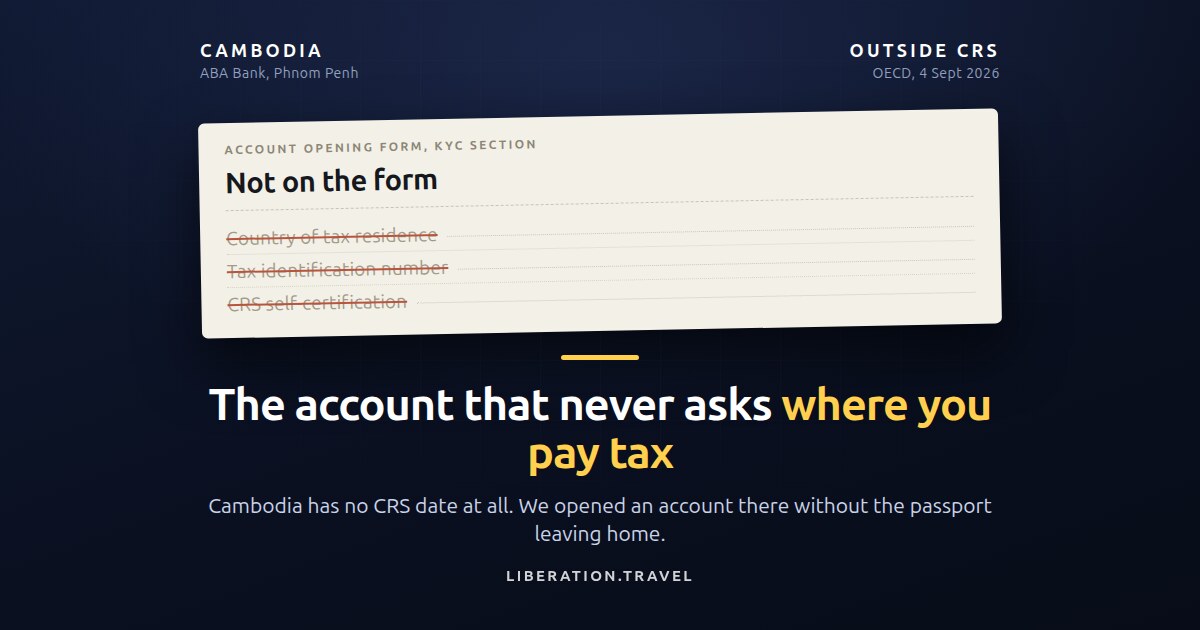
We now open a third account for EUR 1,337. The first two are a premium TBC Concept 360 account in Tbilisi and a non-CRS account at ABank in Bishkek. The third one is in Cambodia, at ABA Bank, and it is the strangest of the three: opening it, my passport never left the drawer. Three signed forms, four copies of each, flew to Phnom Penh by courier. Nothing else did.
Open an ABA Bank account →
We do it remotely for EUR 1,337. Your passport stays home.
The form I signed asks about tax residency exactly once: “Are you a U.S. person?” Yes or no. There is no field for your country of tax residence. No tax identification number. No self-certification about where you file. Anyone who has opened an account in the EU, Georgia, Dubai or Panama in the last ten years knows how unusual that form is in 2026.
One thing to be clear about before any of it: an account outside CRS changes who tells your tax office about it, not what you owe or what you have to file. What you are buying is distance from automatic, unexamined disclosure. You are not buying immunity from a properly made request, and you are not buying an exemption from tax.
Fees, rates, visa terms and Cambodia’s CRS position were verified on 11 September 2026 against the sources listed at the end. Where something is our finding rather than a published figure, we say so in the text.
What is in here
- Why now: the CRS map is shrinking
- What ABA is and who owns it
- How we opened it without the passport leaving home
- The form that tells you more than any analysis
- CRS: what you are buying and what you are not
- FATCA: the opposite, if you are American
- What the account costs
- Interest: ABA is deliberately the worst bank in the country
- The tax trap nobody writes about
- What the account actually does
- How you get the physical card
- Funding it for one percent through Binance P2P
- Risks
- Who it is for and who it is not
- An account that costs nothing until you use it
- How we open it
- Questions we get
Why now: the CRS map is shrinking
The OECD maintains a sheet called Status of commitments for the automatic exchange of financial account information. It is a single page that sorts every jurisdiction in the world by when it started, or will start, automatically sending data about foreigners’ accounts to their home tax authorities. The latest version is dated 4 September 2026, a week before this article was written.
It reads like a countdown. Georgia has been exchanging since 2024. Armenia, Morocco, Rwanda, Senegal and Uganda since 2025. Cameroon from 2026. Cabo Verde, Mongolia and Papua New Guinea by 2027. And by 2028: Fiji, Tunisia, Zambia and Paraguay.
Yes, Paraguay. The country every second article about tax residency has recommended for the last five years now has a first-exchange year printed next to its name.
Cambodia sits in a category of its own, and it is hard to miss:
Developing countries not asked to commit and that have not yet set a date for the first year of exchanges (43).
It carries no date and no commitment, and it appears on neither the 2027 nor the 2028 list, because it is not on any list with a year attached to it. Its neighbours in that group are Vietnam, the Philippines, Serbia, Uzbekistan and Sri Lanka.
That is the whole difference between “not exchanging yet” and “not planning to”. The first is a delay. The second is a condition.
What ABA is and who owns it
Advanced Bank of Asia has been operating since 1996 and is Cambodia’s largest commercial bank by assets, deposits, loans and profitability. That is not a line from a brochure; it comes from the National Bank of Cambodia’s annual supervision reports for 2021 to 2025.
Ownership matters more. Since October 2019 the bank has been wholly owned by National Bank of Canada, which holds roughly USD 447 billion in assets. The Canadians bought in at 10% in 2014, went to 42% in 2015, 90% in 2016, and took the rest in 2019.
Numbers rather than impressions. At the end of 2025 ABA held USD 16.2 billion in assets, up seventeen percent on the year, and customer deposits of almost USD 13 billion. The country’s second largest bank, the listed ACLEDA, reported USD 12.0 billion in assets on the same date. The whole Cambodian banking sector holds roughly a hundred billion in assets and 64 billion in deposits from 18.6 million depositors.
One bank therefore accounts for about a sixth of the country’s banking assets and a fifth of all its deposits. It has more than four million customers in a country of seventeen million people, which is close to one Cambodian in four, children included. Together with the three other large banks it earned over three quarters of the entire sector’s profit last year.
None of which means ABA cannot fail. No bank is unsinkable, and Cambodian deposit protection is thin; I cover it under risks. It means that if ABA got into trouble, that would not be an event about your account. It would be an event about the Cambodian banking system and about a Canadian parent twenty-seven times the size of its Cambodian subsidiary. If you are looking for a reason to distrust this particular bank, its size and its owner are not going to be it.

That cuts both ways, and both ways are worth understanding.
First: this is not an offshore shell with a website and a mailbox. It is a retail bank with 106 branches, more than 2,000 self-banking machines, and a B+ rating with a stable outlook from Standard & Poor’s. Your money does not sit inside a legal structure. It sits in an ordinary bank that has to satisfy a Canadian parent and its own correspondent banks.
Second: which is exactly why you should not come here looking for anonymity. KYC is real, the form asks about your source of income, your employer and your political exposure, and a bank under Canadian supervision is not going to look away. Cambodia lacks automatic exchange. It does not lack customer due diligence.
How we opened it without the passport leaving home
Three steps. The first run took us a few weeks; we have tightened it since, and once the client’s paperwork is complete the account is usually open within a week, at most two if something snags at the bank’s end.
Step one: a business visa. Cambodia issues it online through the Ministry of Foreign Affairs portal at evisa.gov.kh. Visa types are lettered, and the one that matters here is Visa E, the ordinary or business visa. It costs USD 35 plus the portal’s service fee, so a little over forty dollars all in. Single entry, valid three months from issue, one month of stay, processed in three working days.
Step two: sign and courier. I signed the forms and sent them to our agent in Cambodia by DHL. I did not send my passport. This is the point where people usually stop me when we discuss opening accounts remotely, and the answer is pleasantly boring: paper travelled, documents did not.
Step three: activation. Once the account existed, a one-time code arrived by SMS to my own, non-Cambodian number. Activating ABA Mobile took five minutes. Since then I have had a fully working bank in my pocket.
That leaves proof of residence. ABA’s published branch requirement is a visa valid six months or longer, or a lease, an employment contract or a business licence, each with at least six months to run. On paper, a one-month e-visa does not meet it. In practice it is looser: the last account we opened went through on an ordinary USD 35 Visa E with one month of stay, and that satisfied the banker.
I am not turning that into a rule. It is one case, not a change of policy, and what gets accepted depends on the branch and on the person behind the counter. That is exactly why our agent represents the client: he knows what to bring where. Promising you that “an e-visa is enough” would be as dishonest as claiming it never is.
The form that tells you more than any analysis
The paperwork I signed is an ordinary personal account application. A few pages, trilingual in English, Khmer and Chinese, nothing exotic. What makes it interesting is not what it is called but what it asks, and what it never asks.
One thing first, so there is no confusion. Opening the account remotely does not rest on some special form for foreigners. It rests on somebody standing in Cambodia on your behalf. The bank runs perfectly ordinary customer checks throughout. This is not a shortcut around the rules, it is extra work.
The only tax residency question is “Are you a U.S. person?” The KYC section asks about the purpose of the account, employment, source of income, monthly income, political exposure, and whether you are a money changer. Country of tax residence is not asked at all. Compare that with any European form, where a self-certification with a TIN is a mandatory attachment.
Tax residency only points inward. One clause commits the client to supplying documents establishing their tax status in Cambodia, specifically a stay of at least 182 days. Where you are resident anywhere else is not the bank’s business.
“The bank requires opening of at least one Khmer Riel (KHR) currency account.” That is why I have a riel account alongside the dollar one. It is not a choice and it is not a mistake. It follows from central bank policy pushing use of the domestic currency.
CRS: what you are buying and what you are not
This is where most articles about “banking privacy” stop being useful.
What you are buying. Once a year, no automatic file leaves Cambodia carrying your name, your balance and your account income to the country where you are tax resident. Not because anyone is dodging it, but because that infrastructure does not exist in Cambodia and is not on the roadmap. The bank does not ask, because it has nobody to answer.
What you are not buying. First, EU tax residents are taxed on worldwide income. Interest credited in Phnom Penh is taxable income whether or not anyone hears about it. The absence of a report does not change the law; it changes the probability of detection, and those are very different things.
Second, Cambodia is a member of the OECD Global Forum and went through a second-round review for exchange of information on request in 2026. If your tax authority asks for records in a specific case and justifies the request, the channel exists. The difference between automatic exchange and exchange on request is the difference between a list that arrives by itself and a letter somebody has to write and defend.
Third, Americans are outside this equation entirely. See the next section.
So the value here is not invisibility. It is resilience: money outside the reach of a single political and banking system, at a bank that will not close your account for having touched crypto, and will not freeze a balance because of a decision made in Brussels.
FATCA: the opposite, if you are American
Cambodia signed a Model 1B agreement with the United States on 14 September 2015. Cambodian financial institutions report US persons’ account data to the General Department of Taxation, which forwards it to the IRS. There is a national portal at fatca.gov.kh and a designated competent authority dealing with the Americans directly.
That is why the form asks about US persons and nothing else. For US citizens and tax residents, Cambodia is not an exception, and this article does not have the point for them that it has for a European.
What the account costs
Short answer: holding it costs nothing. The longer answer is worth reading, because moving money is not free.
| Savings account | Fee |
|---|---|
| Opening balance | 0 |
| Minimum ongoing balance | 0 |
| Monthly account service | Free |
| Mobile banking | Free |
| Debit card issuance | Free |
| Dormant fee | Free |
| Closing the account | Free |
| Balance confirmation letter | USD 10 each |
| Lost or damaged card replacement | USD 5 |
| Abandonment fee, year 4 / year 5 onward | USD 50 / USD 100 per year |
The current account wants USD 100 (or KHR 400,000) as both opening and ongoing balance, and a chequebook costs USD 20 for fifty leaves. Maintenance is free there too. Unless you need cheques or the business online banking, a current account just ties up a hundred dollars for no reason.
Incoming SWIFT
| Currency received | Fee |
|---|---|
| EUR, GBP, CAD, AUD, SGD, THB, CNY, VND, JPY | Free, any amount |
| USD above 10 | 0.10%, minimum USD 10 |
It sounds like a detail. It is not. If you are sending from Europe, send euros. ABA converts to dollars at its own rate and the incoming transfer costs you nothing. On a hundred thousand dollars, the difference between sending euros and sending dollars is a hundred dollars.
And one thing the website does not mention: alongside dollars and riel, a euro account can be opened too. It is not self-service. The bank has to approve it internally and you have to ask. Anyone receiving euros regularly should raise it while the account is being opened, not after.
Outgoing SWIFT is the expensive direction: 0.15% commission with a USD 15 minimum, plus a flat USD 15 cable charge. That makes the floor USD 30 per outgoing transfer, in any currency. Choosing “OUR” so the beneficiary receives the full amount adds USD 30 for dollars, USD 50 for euros and pounds, USD 100 for yen. Cancelling costs USD 30, and an investigation where funds are returned on suspicion of fraud costs USD 100.
Two more things that are not in the tariff. From USD 10,000 upwards the bank wants proof of where the money came from. And you are really paying three parties: ABA, the intermediary bank and the beneficiary’s bank, and ABA cannot tell you the last two in advance.
Which gives this account a clear job: it is an account for receiving and holding money, not for sending it out often. Domestic transfers inside Cambodia are cheap (0.05% outgoing with a USD 5 minimum, incoming free) and the Bakong system makes them instant.
One exception to that rule is worth knowing about. The app can push money straight onto a card through Visa Direct, Mastercard Send or UnionPay MoneyExpress, bypassing SWIFT altogether. The fee is one to two percent of the amount, the ceiling is USD 2,500 per transfer, and the money is usually on the destination card within thirty minutes. Sending from a dollar account to a euro card adds another one to two percent for the conversion. The condition is that the destination card sits on the same scheme: Visa to Visa, Mastercard to Mastercard.
Up to USD 2,500 that is five times cheaper than the cheapest SWIFT and two days faster. Above it there is no choice and SWIFT is what you have. The other channels the app offers are listed further down.
Cards. Issuance is free on all of them and they run for five years. Annual fees, from the bank’s current pages: Visa Classic and Mastercard Standard are free, permanently, not only for the first year. UnionPay Classic USD 5, the local CSS card USD 3, Platinum Lite and Visa Business USD 20, UnionPay Platinum USD 50, full Visa and Mastercard Platinum USD 150. The printed April 2024 tariff still circulating in branches shows USD 5 a year on Visa Classic and Mastercard Standard; it is out of date, in the customer’s favour. Virtual cards are free.
Now the part that will actually cost you money. Withdrawing at an ABA machine is free. Withdrawing at any other bank’s ATM, inside Cambodia or outside it, costs 2% with a USD 5 minimum. And if you ask for a currency other than dollars, add another 2% for conversion. A European pulling euros out of a dollar account therefore pays four percent. This is not a card for daily spending in the eurozone.
And immediately what does not follow from it: a Platinum card changes nothing about those four percent. The printed 2024 tariff does show conversion as free on Platinum, but ABA’s current product pages put 2% on all three Platinum debit cards. What Platinum actually adds here is worth a few dollars a year: free balance inquiries at other banks’ ATMs (on Visa and Mastercard, not UnionPay) and a free release if a machine swallows the card. Platinum is bought for lounges and limits, not for fees.
Airport lounges: the best card is not the most expensive one. Three Platinum cards, three different loyalty programmes:
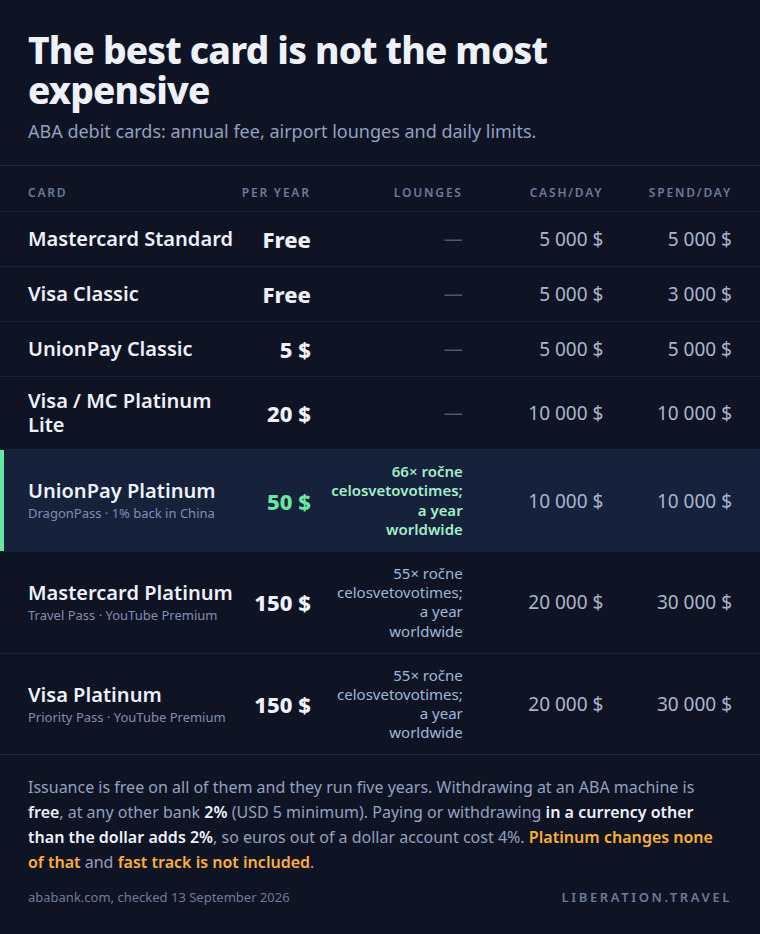
Visa Platinum gives five visits a year through Priority Pass, Mastercard Platinum five through Mastercard Travel Pass, both at USD 150 and both with a year of YouTube Premium thrown in. UnionPay Platinum gives six visits through DragonPass for USD 50, plus 1% back on every transaction in China until the end of 2026, but no YouTube Premium. All three work locally and worldwide.
So on lounges the value is not close: UnionPay Platinum. One extra visit at a third of the price. You pay for it with lower limits, fifty cents per balance inquiry at another bank’s machine, and above all the fact that plenty of European merchants still do not take UnionPay. If you fly and do not spend on the card in Europe, take the UnionPay. If you want a card that works everywhere, pay the USD 150.
Getting into the lounge works differently on each. On Visa you either show the plastic card and say you are coming in on Priority Pass, or show the QR from their app. On Mastercard the card has to be registered in the Mastercard Travel Pass app first or you will not get in. On UnionPay it is the DragonPass app.
And now what is not in there: fast track. None of the three cards includes it. DragonPass and Priority Pass both offer fast track, along with airport restaurant discounts, meet and greet and transfers, but as paid or discounted services inside their own apps. The card gives you exactly the number of lounge visits in the table and nothing else.
Daily limits, if you need them: USD 5,000 cash on a basic card (Visa Classic is capped at USD 3,000 for purchases), USD 10,000 on Platinum Lite, and USD 20,000 cash with USD 30,000 of purchases on full Platinum. A new PIN is free on every card. Replacing a card costs USD 5 to 10, and nothing at all if it was within sixty days of expiring anyway.
Interest: ABA is deliberately the worst bank in the country
This is where most writing about Cambodian banking gets excited about five and seven percent yields. You will not get them at ABA.
The savings account pays exactly zero on dollar balances up to USD 10,000. Above that it climbs in tenths: 0.10% to 25k, 0.25% to 100k, 0.40% to 500k, 0.60% above a million. The riel account pays 1% above twenty million riel.
A twelve-month fixed deposit pays 2.25% in dollars at maturity, 2.75% in riel. Minimum USD 100. Longer terms do not pay more, so a five-year deposit earns the same rate as a one-year one. Partial withdrawal is not allowed, and breaking it early drops you to the savings rate. Deposit USD 3,000 or more and the credit card is free.
Now the context that changes the picture. An independent comparison of twenty-one Cambodian banks from May 2026, twelve-month USD board rates:
| Bank | 12-month USD |
|---|---|
| Sacombank | 4.80% |
| Shinhan Bank Cambodia | 4.60% |
| DGB Bank, KB Prasac | 4.50% |
| PPCBank | 4.40% |
| Woori, Phillip, Sathapana | 4.00% |
| Canadia Bank, Chip Mong | 3.85% |
| ABA Bank | 2.25% |
And that is not the ceiling. Wing Bank pays up to 7% on dollars and 8% on riel on a three-year fixed deposit, with a minimum in the tens of dollars. Shorter terms pay considerably less, around 3.15% at one month. So the seven percent from the top of this section does exist. It just comes with three years of your money locked up, a bank an order of magnitude smaller than ABA, and the tax bill the next section is about.
ABA pays the lowest rate on the entire market. That is not an oversight or bad negotiating. It is the largest and most liquid bank in the country, owned by a Canadian financial group, and it does not need your deposits. Those two and a half percentage points a year are what you pay for safety and for an app that has won its category twelve years running.
If you want a Cambodian account for yield, ABA is not the answer. If you want one that works, and will still be there in five years, it is.
The tax trap nobody writes about
Cambodia withholds 14% on interest paid to a non-resident. Residents pay 6% on fixed deposits and 4% on savings. Bank rates are quoted gross, so the 14% comes off before anything reaches you. That turns 2.25% into 1.935%.
You could live with that. This is the harder part:
Neither Slovakia nor the Czech Republic has a double taxation treaty with Cambodia. We checked this directly against the official register of treaties in force published by the Slovak Ministry of Finance and the overview published by the Czech Ministry of Finance. Vietnam appears in both. Cambodia appears in neither.
The consequence: a Slovak or Czech tax resident has no mechanism to credit or exempt the Cambodian 14%. The interest is taxed in Cambodia and then taxed again at home as investment income. A fixed deposit at ABA is a bad product for an SK or CZ resident, not because of risk, but because of tax. If you are resident somewhere with a treaty, check your own position before assuming otherwise.
The practical conclusion is simple. Keep working money on this account, not savings you expect a return on. Anyone who wants to earn in Cambodia should be solving for tax residency, not for interest rates.
We get asked about reporting obligations, so here is that too: Slovakia has no equivalent of Spain’s Modelo 720 or the American FBAR. An individual does not declare the existence of a foreign account. Income is what gets declared.
What the account actually does
ABA Mobile is the reason for the bank’s reputation. It is not internet banking bolted onto a phone; it is an app that does nearly everything:
- open savings, fixed or flexi deposits from the phone
- send international SWIFT transfers without a branch visit
- issue a virtual card instantly, or order a plastic one
- pay by QR through ABA PAY and KHQR
- pay by QR abroad: Thailand, Vietnam and Malaysia through Bakong, using PromptPay, VietQR Global and DuitNow codes. The payment is free, it comes out of the riel account, and the daily ceiling is 10 million riel in Thailand and Vietnam and 2.9 million in Malaysia, roughly USD 2,500 and USD 700
- withdraw cash from an ATM without a card (E-cash)
- send money out through six channels, not just SWIFT (broken down right below)
- pay bills, top up mobiles, save templates, lock the app with a fingerprint or face
Those channels and their ceilings, which matter more than the count:
| Channel | Ceiling | Cost |
|---|---|---|
| SWIFT | None, but proof of source from USD 10,000 | USD 30 minimum, plus what the other banks take |
| To a card (Visa Direct, Mastercard Send, UnionPay MoneyExpress) | USD 2,500 | 1 to 2% of the amount, usually within 30 minutes, same scheme both ends; USD to EUR adds 1 to 2% conversion |
| MoneyGram, Ria | USD 10,000 | Depends on destination country; cash pickup or straight to an account |
| Western Union | USD 10,000 | Depends on destination country |
| Philippines via DBP | USD 10,000 | USD 4 to 9 |
| South Korea, Thailand | Regional | Varies |
Most of that exists because Cambodia is a remittance country. People send wages home, and home means Manila, Seoul or Bangkok, not Bratislava. For a European customer exactly two of these are useful: SWIFT and the transfer to a card.
Add an escrow service, joint accounts, a trading account you can open from the app, and the option to buy a premium account number that looks like your phone number or your licence plate. In Cambodia that is an ordinary product.
ABA supports neither Apple Pay nor Google Pay. The bank went all in on its own QR standard, and its cards cannot be added to a phone wallet. If you are used to paying with a watch, you will notice.
How you get the physical card
A virtual card is in the app in seconds. The plastic one is more interesting, because all three routes to it assume somebody is physically standing in Cambodia.
You order it in ABA Mobile: Cards, the round red button, Order Plastic Card, card type, the USD account, collection method, confirm with your four-digit PIN. Three options:
| Collection method | Condition | Time |
|---|---|---|
| Card Machine (self-service kiosk) | Classic/Standard and CSS cards only; around 120 locations, branches plus 24/7 spots, nationwide | printed in under 2 minutes |
| Branch pickup | any of the 106 branches | on your visit |
| Free courier delivery | Phnom Penh, Ta Khmao, Kien Svay and Ang Snuol only | a few days |
Three things decide which of those makes sense.
Ninety days. An uncollected, unactivated card is cancelled three months after issue. Ordering one to have it waiting for a trip six months out is wasted effort.
Activation works remotely. The bank says a card is activated “in your ABA Mobile or at any ABA ATM”. The first of those means anywhere on earth. So if the agent collects the card in Phnom Penh and couriers it onward, you activate it yourself at home, as long as it happens inside those ninety days.
A virtual card covers everything online in the meantime. Up to five active cards at once, Visa, Mastercard and UnionPay, the first three free and the fourth and fifth USD 3 each. Two-year validity, a daily limit you can set up to USD 5,000, thirty transactions a day. It links to a dollar account only.
Our recommendation: do not order the plastic card until you know how it gets collected within three months. Either have it delivered to the agent in Phnom Penh and forwarded, or wait for your next trip and use a Card Machine, which takes two minutes and needs no appointment. Until then the virtual card handles everything except cash and in-person POS payments.
Funding it for one percent through Binance P2P
The conventional route, a SWIFT transfer from a European bank, is slow, costs fifteen to thirty euros, and the bank adds one to two percent on the exchange rate. If the money came from crypto, expect questions from the sending bank as well.
The practical route runs through the peer-to-peer market.
- Hold USDT in your Binance wallet.
- In P2P, sell USDT for riel (or dollars), choosing ABA or Bank Transfer (Cambodia) as the payment method. ABA and ABA Pay are the dominant P2P rail in the country, listed by Binance, OKX and Bybit alike.
- The counterparty pays straight into your ABA account and Binance releases the USDT from escrow.
- If riel arrived and you want dollars, convert inside ABA. On 11 September 2026 the bank bought dollars at 4,037 riel and sold at 4,062, a spread of roughly 0.3% one way.
All in, the operation costs about one percent of the amount, plus that third of a percent on conversion. Against SWIFT it wins on both price and speed: minutes instead of two or three days.
And here is what lifts this out of the grey zone. On 26 December 2024 the National Bank of Cambodia issued Prakas B7-024-735 on transactions related to cryptoassets, which expressly permits commercial banks and payment institutions to provide cryptoasset services. It sorts cryptoassets into two groups, the first covering tokenised securities and stablecoins, and allows banks to hold exposure to that first group within limits of 5% and 3%.
So Cambodia is not a country where crypto is tolerated. It is a country that gave stablecoins a regulatory status. For a client that means a much smaller chance of an account being closed for “crypto-related activity”, which in the EU of 2026 is a common experience.
The other side needs saying too. P2P has escrow and counterparty ratings, but it is not risk-free. Trade only with established, verified counterparties. And from a compliance standpoint, a payment from a stranger is a transaction like any other, so keep your records on the source of funds.
And one thing we could not pin down: whether money can move directly between an ABA account and a Binance account. P2P does not work that way. There, the counterparty pays you from their own Cambodian account and it is an ordinary domestic transfer. Until that is confirmed, plan on P2P rather than a direct on and off ramp to the exchange.
Risks
Deposit protection is thin. Cambodia’s deposit protection scheme, run by the central bank, covers roughly KHR 50 million, about USD 12,500, per depositor per bank, in riel and dollars alike. Against EUR 100,000 in the EU that is an order of magnitude less. Above that you are carrying bank risk, which is an argument for ABA and against the banks offering five percent.
The jurisdiction has a reputation problem. In October 2025 the US Treasury’s OFAC designated Prince Group a transnational criminal organisation and sanctioned 146 targets including its head; another thirty-five designations followed in June 2026. A separate FinCEN rule cut Huione Group off from the US financial system. ABA has nothing to do with any of it, but compliance desks worldwide now associate Cambodia with those cases. Expect a transfer from a Cambodian bank to draw more questions than one from Austria.
Cambodia was on the FATF grey list from 2019 until February 2023, when it was removed. It continues to work with the regional APG body.
De-dollarisation is under way. The riel’s share of Bakong transactions rose from 16.7% in 2020 to 58.2% in 2025, and from 2026 the central bank is pushing for at least a quarter of employees to be paid in riel. The mandatory riel account is the first visible symptom. Dollarisation will not disappear overnight, but the direction is one-way.
The account must not fall asleep. The tariff says that if no transaction touches any of your accounts for four years, the bank takes USD 50 in year four and USD 100 every year from the fifth. Our contact at the bank puts the start earlier, at around USD 10 in the second year. Ask for the exact figure when you open. Either way, moving the account occasionally makes the question go away.
This is not anonymity. KYC is real, the owner is a Canadian financial group, exchange of information on request works, and US persons get reported. Anyone shopping for invisibility is shopping in the wrong place and will find trouble instead.
Who it is for and who it is not
It makes sense if you:
- trade crypto or work around it. Since December 2024 the Cambodian central bank expressly permits banks to serve crypto-asset transactions, so the risk of being closed for “crypto-related activity” is materially lower here than in the European Union. And you can fund the account through Binance P2P in minutes for roughly one percent
- want a second pillar outside the European and American systems, with no automatic report attached
- travel or live in Southeast Asia and want to pay by QR across four countries
- need to receive money from abroad cheaply, especially in euros
- want a backup account with a working card and app that can be set up without boarding a plane
That first group is worth being specific about, because it is by far the largest. The difference from a European bank is not that ABA looks the other way. KYC is the same, the form asks about your source of income, and above USD 10,000 it wants proof of origin like any other bank. The difference is that the Cambodian regulator has recognised crypto-assets and written them into its rules, while Brussels still handles them by telling banks to be careful. A payment from an exchange counterparty is an ordinary domestic transfer here, not a trigger for a compliance review. How to fund the account is set out above, under Binance P2P.
It does not make sense if you:
- are a US citizen or tax resident expecting privacy
- are chasing yield: 2.25% minus a 14% withholding with no treaty behind it is not an offer, it is a loss
- want to park a large sum and are not willing to carry bank risk above USD 12,500
- will be sending money out frequently, because a USD 30 floor per transfer is a lot
- think outside CRS means outside the tax system
An account that costs nothing until you use it
This is the part people skim, and it is the part that decides whether a Cambodian account is worth holding as a standby. The ABA savings account has no opening deposit, no minimum balance and no monthly fee. Card issuance is free, and the annual fee is free as well on Visa Classic and Mastercard Standard, permanently, not merely for the first year. Virtual cards are free. Incoming SWIFT in euros is free.
Add it up. Opening zero, minimum balance zero, maintenance zero, card zero. For the first three years the account costs you nothing at all, even if you never touch it. Money only leaves when you do something with it: outgoing SWIFT from USD 30, a foreign ATM at 2% plus 2% for the conversion. From the fourth year of complete inactivity a dormancy fee appears, which I cover under risks, and sending a single dollar once a year keeps it away.
Which is why this is not only a way to move money. It is a second pillar outside one political and banking system, one you can hold unused for the price of a single transfer every few years. On top of that: a jurisdiction with no automatic exchange and no year set for starting one, and a bank that will not close your account because you hold bitcoin.
If that reads like marketing, open ABA’s own tariff and look for the line we left out. We listed them all above, the unpleasant ones included.
How we open it
We open the Cambodian ABA account for EUR 1,337. That is exactly what we charge for a premium TBC Concept 360 account in Georgia and for a non-CRS account at ABank in Kyrgyzstan. We price them the same on purpose: when three accounts cost the same, nobody picks the cheap one, they pick the one that does what they need.
Put simply: Georgia buys travel benefits, Kyrgyzstan buys privacy, and Cambodia buys privacy plus usability. ABA has the best app of the three, the dollar as a domestic currency, and a Canadian owner. It pays for that with the lowest interest rates in the country.
The price covers preparing and checking the forms, the proof of residence, representation by our agent in Cambodia, document delivery, and help with activating the app and funding the account the first time. The client pays for the visa separately: USD 35 plus the portal’s service fee. You sign paper and send it by courier. Your passport stays home.
You can order the ABA account opening here, for EUR 1,337.
Or write to us first and tell us what the account is supposed to do. If Georgia or Kyrgyzstan is the better fit, we will say so.
Questions we get
Do you arrange the visa for me? No. You apply for it yourself at evisa.gov.kh, and it is the first step. It costs USD 35 plus the portal’s fee, takes three working days, and is not included in the price. We can only begin once you have it.
Do I have to travel to Cambodia? Not to open the account. To collect a physical card, yes, unless it goes to the agent in Phnom Penh who forwards it to you. The virtual card works immediately and covers online payments.
Do I send my passport? No. Only signed forms go by courier.
How do I log into the app without a Cambodian number? The one-time code arrives on your normal number. Activation took me five minutes.
Why do I have a riel account I never asked for? Because the bank requires it. It is written into the application form and it follows central bank policy on domestic currency use. It costs nothing and you do not have to keep anything on it.
Is this legal? Opening and holding the account, yes. What you do with it and what you declare is your responsibility. Once more for the record: outside CRS means nobody reports it automatically, not that you owe no tax on it.
What if Cambodia joins CRS? You will know well in advance, because commitments are announced years ahead and the OECD sheet is updated continuously. That is precisely what has just happened to Paraguay, which now carries the year 2028. We watch it and we tell clients.
Can I have this if I already hold the Georgian or Kyrgyz account? Yes, and some clients hold two. These accounts do not compete; each solves something different.
Sources
OECD Global Forum, Status of commitments for the automatic exchange of financial account information, updated 4 September 2026 · ABA Bank (profile, fees, rates, cards, app, exchange rates) · Annual Supervision Report 2025, National Bank of Cambodia (sector size and bank standings) · ACLEDA Bank annual report 2025 · evisa.gov.kh, Ministry of Foreign Affairs of Cambodia · Prakas B7-024-735 on transactions related to cryptoassets, NBC, 26 December 2024 · Cambodia-US FATCA agreement, 14 September 2015 · PwC Worldwide Tax Summaries, Cambodian withholding taxes · Register of double taxation treaties in force, Slovak Ministry of Finance · Overview of treaties in force, Czech Ministry of Finance · Basel Institute on Governance, Cambodia’s FATF grey list delisting · US Embassy Phnom Penh, Prince Group sanctions