
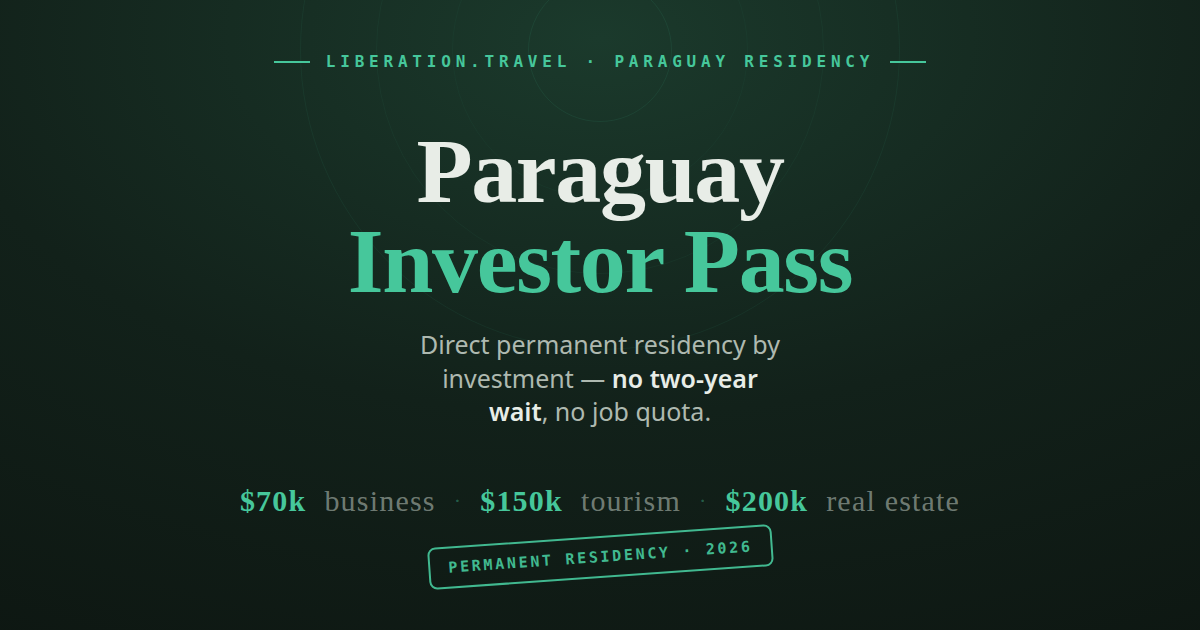
In April 2026 Paraguay opened a new lane to residency: invest, and receive permanent residency directly, no two-year wait. At the same time, the classic route tightened. Here’s every way to become a Paraguayan resident in 2026, what each one costs, and how to choose.
Two big changes in 2026
For years, Paraguay has been the quiet favourite of the residency world: low cost, political stability, and a territorial tax system that leaves foreign income untaxed. Getting residency there has never been the fastest or least bureaucratic process, but it has long been one of the most affordable options out there. In 2026, two things changed at once.
- A new fast lane, the Investor Pass. Resolution MIC N.° 0283/2026 (in force since 28 April 2026) lets qualifying investors go straight to permanent residency, skipping the usual two-year temporary stage entirely.
- A tighter classic route. Resolution DNM N.° 407/2026 (for applications filed from 6 July 2026) overhauls how ordinary applicants prove they can support themselves. A university diploma or a token bank balance is no longer enough.
Let’s take the two live routes in turn.
Route A — The classic route (temporary → permanent)
This is the path most people still take, and it remains one of the most accessible in the world:
- Enter and apply for temporary residency.
- Hold it for two years.
- Convert to permanent residency.
The trips themselves are short: each filing (first for temporary residency, then later for permanent) needs only about three working days on the ground. While you hold temporary residency, though, one rule matters: you must visit Paraguay at least once a year (within 365 days of your residence card being issued, or of your last visit, whichever is later) or the temporary residency can lapse.
What changed in 2026 is step 3. Under Resolution 407/2026, you now prove “economic solvency” by qualifying under one of 12 categories — professional, technician, employee, independent trader, remote worker / digital nomad, property owner, company shareholder, farmer or rancher, religious worker, retiree / pensioner, dependent, or student. There is no single fixed amount set in law; instead, each category has its own documentary proof (an employment contract, recent tax filings, a pension certificate, an apostilled work contract for remote income, and so on). In practice, though, a sensible benchmark is monthly income at least at the level of Paraguay’s minimum wage (₲3,044,000 a month since July 2026, about US$505 at the August 2026 rate of roughly ₲6,000 to the dollar) and ideally closer to the average private-sector wage, which the national statistics institute INE put at ₲3,465,100 a month in the second quarter of 2026 (about US$580). The key shift: a diploma on its own no longer counts. You must show real, paid, verifiable activity.
If the classic route is your path, we cover it in depth in two companion guides: our step-by-step Paraguay residency walkthrough and the full breakdown of the new 2026 solvency conditions.
Route B — The Investor Pass (direct permanent residency)
This is the headline change of 2026. If you’re willing to invest, you can now bypass the two-year temporary stage and receive permanent residency directly.
How it works. The Ministry of Industry and Commerce (MIC), through its one-stop investment office SUACE, issues a Foreign Investor Certificate (CIE — Constancia de Inversionista Extranjero). With that certificate in hand, the Directorate of Migration (DNM) grants your permanent-residency card. The legal basis is Article 46 of Migration Law 6984/2022, which lets qualifying investors skip the temporary-residence prerequisite.
Step by step, it looks like this:
- Choose your track, business, tourism, real estate or financial.
- Make, or formally commit to, the investment.
- SUACE issues the CIE, within five business days of a complete file.
- DNM issues your permanent-residency card.
Here are the four investment tracks in detail:
| Track | Minimum investment | Key conditions |
|---|---|---|
| Business (productive / commercial-industrial, via SUACE) | US$70,000 | Create at least 5 formal jobs for Paraguayans, plus a business plan approved by MIC. In practice this route is usually the most bureaucratic. |
| Tourism | US$150,000 | Invest in tourism infrastructure, services or activities; a business plan is required, with periodic progress reports |
| Real estate | US$200,000 | The property must be income-generating, rented out or economically used; a home for your own personal or family use does not qualify. A pre-construction option lets you file once 30% (US$60,000) is paid. |
| Financial instruments / stock market | US$200,000 | Held for a minimum of 2 years; no jobs or business plan, but annual reporting |
A few details worth knowing:
- It’s fast on paper. Once your file is complete, SUACE must issue the CIE within five business days — the clock only pauses if they ask for corrections.
- Pre-construction property counts. On the real-estate track you don’t need a finished, registered property. With a notarized private purchase contract and at least 30% of the value paid (US$60,000 on a US$200,000 deal), you can file. The balance is documented as your commitment during construction.
- Fresh paperwork. Supporting documents for the real-estate and financial tracks must be dated within the last 180 days.
- Clean money only. You’ll sign a sworn declaration of the source of your funds, coordinated with Paraguay’s anti-money-laundering authority (SEPRELAD).
- The investment has to stay live. These are investment-based residencies — you’re expected to keep the investment in place, and some tracks come with ongoing reporting obligations (as noted in the table above).
- You still have to show up, just far less often. The Investor Pass spares you the temporary stage and its annual visit, but permanent residency comes with a presence rule of its own: under Article 55 of Migration Law 6984/2022 you must not spend more than three consecutive years outside Paraguay (in practice, one visit every three years) and any single entry resets the clock. The permanent-residency carnet is also issued with a 10-year validity and has to be renewed when it expires. Investing does not buy you out of either obligation; it only removes the two-year temporary stage in front of them. (If you are aiming for citizenship rather than residency, the presence bar is far higher, see below.)
- If you need to be away longer, ask before the limit runs out. Under DNM Resolution N° 376/2026 (signed 13 May, published August 2026) a permanent resident can be authorised up to one extra year abroad, applied for up to 3 months before the three-year limit expires, for a fee of 2 jornales (₲234,154, about US$39), with a decision in 10 business days. Ask after the limit has passed and the same resolution is merciless: the request is refused and the residency cancelled. DNM sweeps the movement records every six months and notifies cancellations to the email address in your application. We cover the whole procedure, including how to recover a cancelled permanent residency, in the 2026 solvency guide.
And to kill a rumour doing the rounds: there is no US$40,000 “film” or “creative” track. The regulation has exactly four tracks, nothing cheaper.
Investor Pass vs. the classic route
| Investor Pass | Classic route | |
|---|---|---|
| What you get | Direct permanent residency | Temporary first, then permanent |
| Time to permanent residency | Fast (CIE in 5 business days, then the residency card follows | ~2 years on temporary + processing |
| Presence required | One visit every 3 years (the permanent-residency rule) | Once a year through the two-year temporary stage, then every 3 years |
| Money required | From $70k (business) / $150k (tourism) / $200k (real estate or stocks) | No fixed minimum) qualify under a solvency category |
| Job creation | Only the business track (5 jobs) | None |
| Legal basis | Res. MIC 0283/2026 (+ Law 6984/2022, Art. 46) | Law 6984/2022 + Res. DNM 407/2026 |
Neither route is “better”, they serve different people. If you have $70,000+ to invest and value speed, the Investor Pass is transformative: you reach permanent residency far faster, with no need to maintain temporary status or return every single year through a two-year wait — though, as above, permanent residency itself still asks you back once every three years. On the real-estate route we generally recommend investing above the minimum. A stronger, genuinely income-generating property is the safer, more comfortable choice. If you’re a remote worker, retiree or employee who’d rather not lock up capital, the classic route is still relatively affordable and open.
From permanent residency to citizenship
Permanent residency is the finish line for most people. It’s effectively indefinite and comes with that tax-friendly territorial system. But if you’re aiming for a Paraguayan passport, here’s the shape of it.
Under Article 148 of the Constitution, naturalization requires: legal age, a minimum of three years’ residence (counted, in practice, from when you hold permanent residency — time on temporary residency doesn’t count), the exercise of a profession, trade, science, art or industry, and good conduct. There’s a catch that residency itself doesn’t have: to naturalize you must show genuine ties, arraigo, to Paraguay. Neither the Constitution nor the migration law fixes a day-count, but in current practice the Supreme Court looks for real physical presence, on the order of six months a year (with no long absences) across those three years. So while the Investor Pass gets you to permanent residency far faster, the passport still asks you to actually spend time in the country. The application also involves around a dozen documents and a Supreme Court exam covering basic Spanish or Guaraní plus Paraguayan history, geography and civics. Timelines vary, so treat three years as the floor, not a promise.
And a word on dual citizenship. Paraguay’s Constitution (Article 149) formally recognizes dual nationality only where a reciprocity treaty exists, in practice, that means Spain and Italy. For everyone else, the naturalization oath includes a verbal renunciation of your former citizenship, but Paraguay doesn’t ask for your old passport, doesn’t verify the renunciation and doesn’t notify your home country, so most people keep their original nationality in practice. Whether you legally keep it depends on your own country’s rules, not Paraguay’s, so it’s worth getting individual advice on your specific case.
The passport is no small prize: visa-free or visa-on-arrival access to around 145 destinations (Henley Passport Index, 2026), plus Mercosur free-movement and residence rights across Argentina, Brazil, Uruguay and Bolivia.
Which route is right for you?
- You have capital and want residency now → the Investor Pass. Real estate ($200k in a rental or income-generating property, not your own home, or $60k down on pre-construction) or a business ($70k + jobs) if you want to be hands-on; tourism ($150k) or a two-year stock-market hold ($200k) if you’d rather stay passive.
- You’re a digital nomad, remote worker or freelancer → the classic route — prove income under the remote-worker category, with no large cash lock-up.
- You’re a retiree or pensioner → the classic route with a pension certificate, or the Investor Pass if you’d rather buy in and skip the two-year wait.
We’ll handle the whole thing
Both routes reward getting the paperwork exactly right. The wrong category, a stale document, or a badly drafted source-of-funds declaration is where applications stall. That’s our job. We’ve helped clients obtain Paraguayan residency for years (over 1,000 across Latin America) working hands-on with the SUACE / MIC and Migration processes. We take you end-to-end: choosing the right route, structuring the investment, preparing and apostilling every document, and walking your file through to the residency card. And we’re already onboarding our first Investor Pass clients, so you’d be working with a team that’s hands-on with the brand-new process, not just reading about it.
Government and service fees sit on top of the investment and vary by route, just ask us and we’ll give you exact figures for your case.
Thinking about Paraguay? Get in touch and we’ll map the fastest route for your situation, or read more about what we do on the ground in Paraguay.
This guide reflects Resolution MIC N.° 0283/2026 (the Investor Pass) and Resolution DNM N.° 407/2026 (classic-route solvency), both current as of 2026. These rules are new and implementation is still settling, we keep our process up to date.