
You’ve done the reading. You see where the EU is heading and you want a plan B. Your partner has parents here, a job, the kids have friends, and moving abroad is out of the question. This article is for exactly that situation. A plan B is not all-or-nothing. There are four scenarios with a different degree of exit, from a pure insurance policy to a new home on the other side of the world. With facts, numbers and the actual paragraphs of law, because family decisions deserve better than vibes.
(This article is based on my talk of the same name. The full slide deck is at the end, HTML and PDF, in English and Slovak.)
You want to leave. They want to stay.
Almost every family I’ve helped with a residency starts from the same asymmetry. One partner reads the news about cash limits, chat control and the digital euro and wants an exit ready. The other hears “Paraguay” and thinks: grandparents, school, friends, our whole life is here.
Both are right. And the good news is you don’t have to choose between “everything stays the same” and “we emigrate”. There are, in fact, several scenarios:
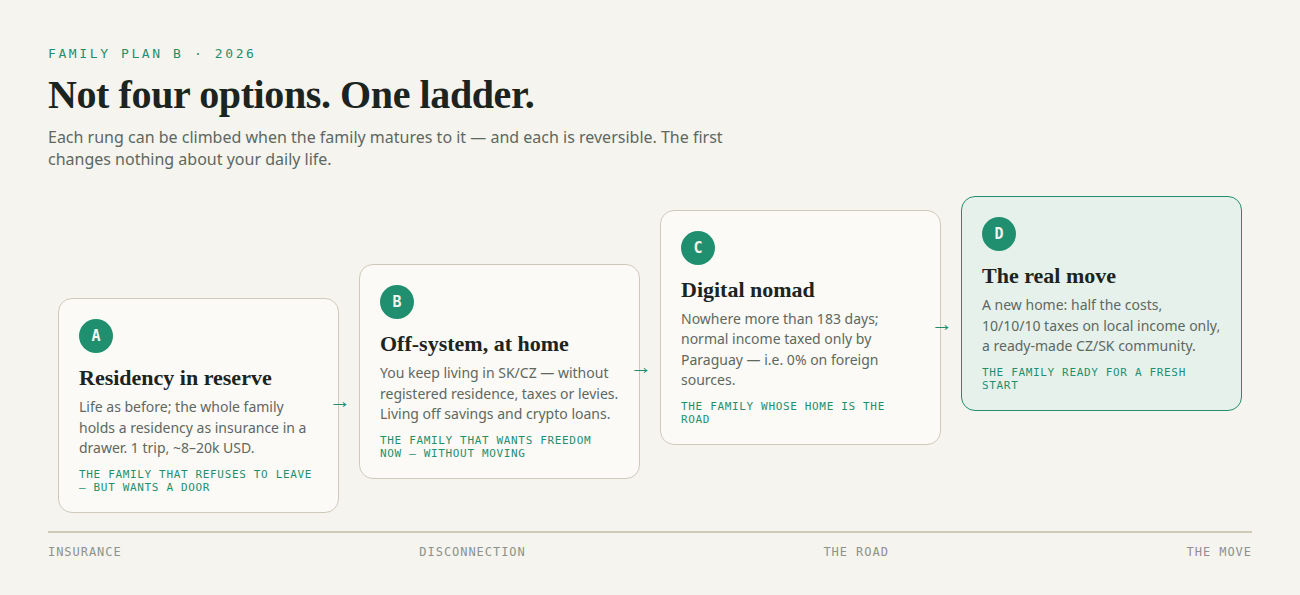
- Scenario A, a residency in reserve. The family lives exactly as before; everyone holds a second residency as insurance.
- Scenario B, out of the system, at home. The family stays in Slovakia or Czechia physically, but steps out of the tax and levy system.
- Scenario C, digital nomad. The family travels, never staying anywhere long enough to become tax resident.
- Scenario D, the real move. The family relocates to Paraguay (or Uruguay, or Panama).
Each step can be taken years after the previous one, when the family is ready. The first one doesn’t hurt at all.
Before the scenarios, though: why are Czech and Slovak families looking at the door in the first place? Three reasons come up over and over, schooling, money, and freedom.
Reason 1: your kids’ education is a permission, not a right
In Slovakia, homeschooling is legal only as an exception. The educator must hold a master’s degree in teaching for the given stage of primary school (§ 24 of Act 245/2008). Being a parent is not enough, you need a “guarantor” with the right diploma. The child stays enrolled in a brick-and-mortar school, which examines them every half-year. Grades 5–9 could not be homeschooled at all until January 2022. An amendment effective from 2026 makes the process somewhat friendlier (portfolio assessment, a single examiner, multi-year permission. Though exams must now happen in person), but the teaching-diploma condition stays.
Czechia is looser but it works the same way. Homeschooling exists at the discretion of the school director, requires “serious reasons”, a counselling-centre opinion and half-yearly exams, and the permission can be withdrawn at any time (§ 41 of Act 561/2004). Demand keeps breaking records; the system keeps it on a leash.
Now the same children, different jurisdictions:
| Country | Homeschooling | In practice |
|---|---|---|
| 🇸🇰 Slovakia | strict exception | only via a guarantor with a teaching degree, half-yearly exams |
| 🇨🇿 Czechia | restricted | maturita/university degree, director’s permission, exams |
| 🇩🇪 Germany | banned | compulsory attendance with no exemption since 1919; fines up to loss of custody (upheld by the ECtHR (Wunderlich, 2019) |
| 🇸🇪 Sweden | de facto banned | since 2011 only in “exceptional circumstances”) permits practically never granted; families emigrate |
| 🇺🇾 Uruguay | de facto yes | constitution guarantees freedom of teaching; an appeals court confirmed families’ right in 2025 (a final appeal is still pending) |
| 🇵🇾 Paraguay | nobody checks | no regulation, no enforcement; expat kids run through foreign umbrella schools |
| 🇵🇦 Panama | explicitly legal | Law 245/2021 (register with the ministry, annual evaluation |
In July 2025 a Uruguayan appellate court confirmed the right of Mennonite families to homeschool their 11 children, on constitutional grounds (Article 68, libertad de enseñanza)) the education authority has taken the case to the Supreme Court, so the win isn’t final yet, but the families keep teaching in the meantime. In Paraguay, education is formally compulsory, but homeschooling simply isn’t regulated and nobody enforces anything against foreigners. In Panama it’s black-letter law (Law 245/2021, rolled out through a pilot programme since 2024). And note the German and Swedish rows: families emigrate over homeschooling from Western Europe too (German families leave for neighbouring Austria or overseas, Swedish ones relocate to the Åland Islands) and, surprisingly often, to Prague. This is not some Eastern European paranoia.
The point isn’t that everyone should homeschool. The point is who decides: you, or an official.
Reason 2: the same standard of living for half the money
Numbers from Numbeo (mid-2026), comparing what a family of four actually spends:
| Monthly (EUR) | Bratislava | Prague | Asunción |
|---|---|---|---|
| Family 2+2, without housing | 2,992 | 2,796 | 1,917 |
| 3-bedroom flat outside the centre | 1,161 | 1,438 | 539 |
| Total with housing | ≈ 4,150 | ≈ 4,230 | ≈ 2,460 |
Basic groceries for kids are 30–50% cheaper in Asunción (eggs −50%, chicken −47%, cheese −44% vs Bratislava). A private kindergarten costs €177 a month against €680 in Bratislava and €955 in Prague. A full-time nanny runs €130–480 a month; in Bratislava you’d pay around €1,400.
To be fair, not everything is cheaper: imported temperate-climate fruit costs more (apples +25%), and salt, absurdly, more than double, landlocked Paraguay imports it. Milk costs the same. But the total is a household budget cut roughly in half, in a country that taxes local income at 10% and foreign income at 0%.
Reason 3: the freedoms families actually feel
Abstract “freedom indexes” don’t persuade a skeptical spouse. These do:
- Child vaccination. Slovakia: mandatory, fines up to €331. Czechia: fines up to 10,000 CZK and exclusion from preschool — an approach the European Court of Human Rights blessed in Vavřička v. Czech Republic (2021). Paraguay, Uruguay, Panama: mandatory on paper, no fines, not enforced in practice.
- Cash. The EU has a €10,000 cash-payment cap coming in July 2027, with ID checks from €3,000 (Regulation 2024/1624). Slovakia didn’t wait: a €5,000 limit for business transactions has been in force since January 2026. Paraguay and Panama have no limits; Uruguay caps only very large transactions (1 million UI, currently about 160,000 USD).
- CBDC. The digital euro is in preparation, pilot 2027, possible issuance 2029. Paraguay and Panama have no CBDC project at all.
- Private messages. “Chat control” had a busy July 2026: the European Parliament failed to block the extension of voluntary message scanning, which now runs until April 2028, and the mandatory-scanning regulation (CSAR) sits in trilogue with the next round in September. Nothing similar exists in Latin America.
- Taxes on work. The Slovak tax wedge is 42.7%, seventh highest in the OECD (Taxing Wages 2026). The Czech one is 41.2%. All three Latin American countries tax territorially: foreign income simply isn’t taxed.
None of this is a conspiracy theory; every item has a law number or an official communication behind it. It’s just the direction of travel, and the reason a growing number of families want at least a door out, even if they never walk through it.
Scenario A: a residency in reserve
The mildest scenario, and the one most families start with. Nothing about your life changes. You take one trip, and from then on every member of the family, kids included, holds a permanent legal status in a neutral country on the other side of the world.
Why bother? Recall 2020: whoever held a second residency could legally travel “home” during lockdowns. Others couldn’t leave their own district. Insurance is bought when you don’t need it; once things start burning, offices get flooded and rules tighten.
Why Paraguay specifically:
- One trip of about a week. You file the application and biometrics in Asunción; the approval (3–4 months) runs without you.
- No money obligations. No investment, no deposit, no taxes or levies unless you have local income. One 2026 change to know about: since 6 July, permanent-residency applicants prove “economic solvency” under one of 12 categories (Resolution DNM 407/2026) — a diploma alone no longer cuts it, you show real, verifiable activity. Manageable, but it rewards doing the paperwork properly.
- Presence is a diary entry, not a lifestyle, but it is now checked. A temporary residency (2 years) is kept alive by one entry into the country per 365 days, permanent residency by one entry every three years (Article 55 of Law 6984/2022, any single entry resets the clock). Since August 2026 those limits are actually enforced: under Resolution DNM 376/2026 Migraciones sweeps the border records every six months and cancels residencies that have overrun, by administrative act, notified only to the email address you gave on the application. A longer absence can be authorised in advance, up to one extra year for permanent residents, but asking after the limit has passed is refused and cancels the residency.
- Kids are included, and they do not have to prove anything. Minors apply together with their parents. The extra paperwork is apostilled birth certificates and both parents’ signatures. Children aged 0–17 form a category of their own (Niños, Niñas y Adolescentes) and are exempt from the economic-solvency proof; the parent carries it, and under-14s are also exempt from police and Interpol record certificates. They get the same residency and the same cédula (ID card).
- No 183-day condition. You don’t have to live there a single day a year. Tax residency is an available bonus, not an obligation.
⚠️ The one date a “residency in reserve” family must not miss.
The mandatory visit inside the first 365 days is not only about keeping the temporary residency alive. Under Resolution DNM 081/2026 the change of category from temporary to permanent includes a free Informe de Movimiento Migratorio, and if it shows more than one continuous year outside Paraguay you do not get permanent residency — you get an extension of the temporary residency for the same term and wait again. We tell clients to take that trip as late as the window allows, around days 300–365, so the next journey can already be the permanent-residency filing.
Family maths: a 2+2 family runs roughly 8–20 thousand USD one-off, depending on the package and travel. That’s a lifetime insurance policy for about the price of one year of an international school in Bratislava.
Why not Uruguay as the backup? For adults it works, Uruguay now grants permanent residency directly and doesn’t check whether you actually live there. But if you want residency for the children too, Uruguay expects the kids to actually attend school there (or be homeschooled physically in the country). A family paper-residency held from Europe isn’t a thing. Uruguay is a plan A country: wonderful to actually live in, and the only realistic choice of the three for LGBT families — same-sex marriage since 2013, joint adoption since 2009, third place worldwide on the Equaldex equality index. But as a family backup, it doesn’t work.
Panama: works, but more complicated. The Friendly Nations Visa (Slovaks and Czechs qualify) runs via a work contract in a Panamanian company we set up for you, no investment needed. Since the 2021 rule change it’s a two-stage affair: a 2-year provisional residency first, permanent after that, about 3 years and 4 visits in total. The Qualified Investor route (300,000 USD in a new-build property, or 500,000 USD in a resale one, under the September 2026 decree) gets permanent residency in roughly 30–90 days and can be started remotely. Kids join as dependents without any presence condition, but the family application needs a local bank account with a 5,000 USD deposit. One plus: Panama files the whole family as one application, so a bigger family can come out cheaper than in Paraguay, where every person pays separately.
The verdict in one line: Paraguay is the ideal family backup, Panama the more complex alternative, Uruguay only without kids.
For the three countries compared beyond the family angle, read our Paraguay vs Uruguay vs Panama comparison or take the residency quiz.
Scenario B: stay home, leave the system
This is the scenario for families that won’t move, and it’s the most intellectually interesting one, because it converts “we’re not leaving” from a defeat into a strategy. The family keeps living in Slovakia or Czechia. What leaves is the paperwork.
Three steps:
- Deregister your permanent residence. A Slovak or Czech citizen doesn’t need a registered permanent residence to live in their own country. The registration has, in the law’s own words, “evidenčný charakter” — it’s a record, not a permission (§ 3(3) of Act 253/1998; Article 23 of the constitution guarantees a citizen can’t be expelled from their homeland). Deregistering takes minutes and doesn’t touch property ownership.
- Use a Paraguayan residency as your official address towards banks, authorities and documents — obtained exactly as in scenario A, in one trip.
- Have no official personal income. Live off savings and crypto-backed loans. You typically remain a tax resident of SR/ČR (183+ days), but a resident with no income owes no income tax, and “loans and credit are not subject to tax” is literally in the statute (§ 3(2)(b) of Act 595/2003; the Czech equivalent is § 3(4) of Act 586/1992). Your companies, meanwhile, keep earning normally — this regime concerns you as a natural person, not your business.
What falls away with the registered residence: mandatory public health insurance. In Slovakia the obligation is tied to permanent residence (§ 3 of Act 580/2004); in Czechia insurance “terminates upon ending permanent residence” verbatim (§ 3(2) of Act 48/1997). Instead of minimum levies of €121.92 per adult per month (2026 rate, with no contract about what you’re owed in return), you buy a real global family policy, I use William Russell; a 2+2 family runs from about 4,600 USD a year (Bronze) to 8,400 USD (Silver), covering private care in Europe and Latin America alike.
An honest warning that belongs in every version of this article: switch to private insurance while you’re all healthy. With a serious diagnosis, no private insurer will take you. The reverse door stays open. The public system must re-insure you by law the moment you re-register.
How do you actually live off loans? You post bitcoin as collateral and draw a loan in euros or stablecoins. Firefish (CeFi, 5–15% p.a., fiat straight to a bank account, a paper contract for the record) or Aave with tBTC (DeFi, ~3–4.5% p.a., no KYC). Drawing a loan is not a taxable event — you’re receiving someone else’s money and giving it back. At a conservative LTV of 25–35%, it takes roughly a 60% bitcoin crash to threaten liquidation.
A worked example. Marek sells bitcoin with a €45,000 gain: progressive tax of 19–35% plus 16% health levies takes €15,750–22,950, up to about half the gain, immediately. (Slovakia scrapped its time-test exemption before it ever took effect; Czechia, more sensibly, exempts sales after 3 years of holding since 2025, capped at 40 million CZK a year.) The same Marek borrowing €20,000 against his BTC at 4.5% pays €900 a year in interest, keeps the bitcoin, and triggers no taxable event at all. Even after ten years of interest he’s far ahead, and if his BTC grows, dramatically so. The full method, with the tax analysis, is in How to Live Off a Crypto Loan Long-Term, and Legally Pay No Tax, in 2026.
Practical life without a registered residence, honestly:
- Driving licence: the EU won’t issue one without residence (the 185-day rule), so you drive on the Paraguayan licence, valid in Europe via the 1949 Geneva Convention (in Germany carry a certified translation or an international permit).
- Banking: accounts outside the EU (Georgian TBC, the Kyrgyz non-CRS Aiyl bank) plus Bitcoin/Lightning and cash.
- Kids and school attendance: in Slovakia, compulsory attendance is enforced through the municipal register, which runs on permanent residence — a child without a registered residence isn’t in it. This is a grey zone, not an exemption; the fine if challenged is €30–331. Czechia is different: the duty follows citizenship, so use the legal routes — § 38 (fulfilment abroad) or § 41 (individual education). Either way, our recommendation is the same: enrol the kids somewhere (enrolment works fine without permanent residence, based on habitual residence) or add an umbrella school, so they always have papers valid anywhere. This is about freedom of form, not about children without an education.
- Living across the border (SK ↔ CZ): in your own country, as a citizen, no registration duty exists at all. In Slovakia reporting a temporary stay is a right, not an obligation (§ 8 of Act 253/1998), and Czechia doesn’t even have the institute for its own citizens. But if scenario B for you means settling in the neighbouring country as an EU citizen, the clocks do run: in Slovakia you must apply for EU-citizen residence registration after 3 months of continuous stay (§ 66 of Act 404/2011, fine up to €165); in Czechia you must report your address to the police within 30 days of arrival if the stay will exceed 30 days (§ 93 of Act 326/1999). The legal fix is simple: the periods run from entry, so an occasional documented trip across the border resets them, keep the receipts.
- What you lose: a mortgage at a bank in the country of your citizenship (if you’re an EU citizen), a firearms licence, municipal voting, child benefits and the tax bonus (roughly €1,500–3,800 a year for two kids). The saved taxes and levies typically exceed that several times over.
And the honest limit of the whole scenario. It works fully only when neither partner needs an employment contract in SR/ČR. An employee is inside the system through their job. Plenty of families run the hybrid: one partner employed and inside, the other outside.
Scenario C: nowhere more than 183 days
The nomad scenario. You keep a Paraguayan tax domicile (territorial: foreign income taxed at 0%) and never stay anywhere long enough to become tax resident — no country, no 183 days, no residency by presence. One precondition: deregister your permanent residence in SR/ČR first, exactly as in scenario B. In Slovakia a registered permanent residence is a standalone criterion of tax residency (§ 2 of Act 595/2003), so a nomad who keeps it stays a Slovak tax resident no matter how much they travel; in Czechia a maintained “permanent home” plays the same role.
The key difference against scenario B: a nomad can have a completely normal official income (salary, dividends, crypto sales) and the only jurisdiction with a claim on it is Paraguay, which doesn’t tax foreign income. No living off loans required.
Two honest warnings. First, the “centre of vital interests”: a flat, a company and a family all sitting in one country can make you tax resident there even without 183 days. You have to actually travel, not just on paper. Second, with kids this is the most demanding scenario. Worldschooling gives children languages, friends on every continent and adaptability no classroom can, but also less stability and harder logistics. Not every child, and not every family, thrives on it. The hybrid works best: part of the year on the road, part at a base — for example Asunción with its Czech and Slovak community, or a rotation of favourite countries, always under 183 days. (Tools: nomadlist.com warns you a month before you hit a limit; chrono.io keeps a GPS log as evidence if a tax office ever asks.)
Schooling on the road is not improvisation, either. It runs through foreign umbrella and online schools that give the kids papers valid anywhere while they learn from anywhere: the American Clonlara School (an accredited umbrella school running since 1967), the British King’s InterHigh (live online lessons, IB track included), Wolsey Hall Oxford (distance learning down the Cambridge pathway) or Galileo (self-directed learning popular with worldschoolers). Czech kids can fulfil compulsory attendance online via Škola Březová (§ 38) while travelling full-time; Slovak kids stay enrolled at their home school and fulfil it by studying abroad (§ 23 of Act 245/2008). Cost-wise it runs on the order of 1–8 thousand USD per child per year (Clonlara 1,350–1,820 USD/yr plus a 3,000 USD international fee; King’s InterHigh 2,750–6,605 GBP/yr; Galileo ~2,000 USD/yr) — a fraction of a brick-and-mortar international school, and less than the family saves on taxes in this scenario.
Scenario D: the real move
The full opt-out: the family relocates and leaves the system for real, not on paper, but address and all.
You won’t be alone. The biggest fear of relocating families isn’t bureaucracy, it’s loneliness, and that one’s been solved in Asunción for years. The Signal community “Paraguayan Beauties” is Czech and Slovak families who actually live there: schools, paediatricians, lawyers, housing, weekend trips. Your kids will have friends who speak Slovak and Czech. You’re arriving into a finished community, not a wilderness.
Schools. Asunción has a full Montessori school (ages 3–12), the US-accredited American School of Asunción (~6,000–9,500 USD/year), Pan American International School (~6,500–10,500 USD/year), plus SEK International (IB) and others. Even the most expensive school in Asunción costs a half to a third of a Bratislava or Prague international school, where tuition runs €15–30 thousand a year depending on the grade.
And how does schooling in the three destination countries compare overall? Briefly: state schools are a defensible choice only in Uruguay — the best PISA results in Latin America, Plan Ceibal putting a laptop in every pupil’s hands, and the tuition-free Udelar university. In Paraguay and Panama, budget for private school: Paraguayan state schools posted the second-worst math score of all 81 systems in PISA 2022 and teach in ~4-hour shifts, and Panama’s state system lost ~80 teaching days to a strike in 2025. The good news: private schools in both countries cost a fraction of European prices.
| Country | State schools (PISA 2022, math/reading/science; OECD avg 472/476/485) | Mid-range private | Top international | Verdict |
|---|---|---|---|---|
| 🇵🇾 Paraguay | 338/373/368—2nd-worst math result of 81 systems; ~4-hour school shifts | ~150–600 USD/mo | ~6–10k USD/yr (ASA) | avoid state schools, but private is very cheap by European standards |
| 🇺🇾 Uruguay | 409/430/435, best in Latin America; Plan Ceibal, tuition-free Udelar university | ~320–720 USD/mo | ~12–22k USD/yr | the only one of the three where a state school is a defensible choice |
| 🇵🇦 Panama | 357/392/388, weak and strike-prone: ~80 teaching days lost in 2025 | ~300–900 USD/mo | ~10–19k USD/yr | budget for private; mid-range bilingual is the sweet spot |
Healthcare. Sanatorio Migone, Centro Médico La Costa and Centro Médico Bautista are private hospitals with 24/7 paediatric ERs, neonatal ICUs and English-speaking doctors. A consultation costs 15–50 USD; a family prepaid plan (medicina prepaga) runs ~150–350 USD a month; appointments happen the next day, not in three weeks. A nanny plus a complete family health plan in Asunción together cost less than the nanny alone in Bratislava.
Money. See Reason 2: the same standard of living for roughly half the budget, taxes of 10/10/10, and only on local income.
Not four options. One ladder.
A → B → C → D aren’t competing products. They’re rungs: insurance → disconnection → the road → the move. Each step can be taken when the family matures to it, each is reversible, and the first one costs less than a year of private school and changes nothing about your daily life.
The questions that come up at the kitchen table
That reversibility is the strongest argument you have at home. These five objections come up every time, and none of them needs a dishonest answer:
I don’t want to leave my parents and friends. Does a plan B still make sense?
Yes – scenario A changes nothing about your life. A second residency is an insurance policy in a drawer, not a plane ticket. The family lives exactly as before; every member simply holds a permanent legal status in a neutral country.
Would the kids lose their school and friends?
Not in scenarios A or B. In scenario B the family keeps living in Slovakia or Czechia among their friends – what changes is the paperwork around them: deregistered permanent residence, a Paraguayan residency as the official address, and a global health policy instead of public levies.
What if someone gets sick without public health insurance?
A global family policy (e.g. William Russell, roughly 4,600-8,400 USD a year for a family of four) covers private care in Europe and Latin America, and in Asuncion the top private hospitals see you the next day. The key rule: switch while everyone is healthy – private insurers won’t take you with a serious diagnosis. The public system must re-insure you by law the moment you re-register.
What if it doesn’t work out? Is any of this permanent?
Everything is reversible. Permanent residence can be re-registered on the spot, public health insurance must take you back by law, and a residency you stop maintaining is simply cancelled by Migraciones for absence under Resolution DNM 376/2026 – you lose the status, nothing else.
How much does a family plan B cost?
Scenario A (a Paraguayan residency for the whole family) runs roughly 8-20 thousand USD one-off – about one year of international-school tuition in Bratislava. Scenario B pays for itself: the saved taxes and levies typically exceed the lost benefits several times over.
The first five steps
- Pick the scenario together.
- Apostille birth and marriage certificates. The foundation of every residency, reusable forever.
- Take out global health insurance while everyone is healthy. This is the only step with a deadline nobody announces in advance.
- Test a crypto loan in the small. 0.01 BTC, €100, and two hours with a tax adviser.
- Plan a week in Asunción. Residency for the whole family in one trip, we run it end-to-end at liberation.travel, and you’ll meet the community while you’re there.
A plan B is not a betrayal of their home. It’s the insurance that lets you stay in it calmly. Step out, even if only on paper.
The talk this article comes from
The full slide deck (40 slides: all the tables, law citations and sources in one place):
- English: From Family Plan B to a Complete Family Opt-Out from the System (HTML) · PDF
- Slovak (original): Od rodinného plánu B až po kompletný opt-out rodiny zo systému (HTML) · PDF
- Czech: Od rodinného plánu B až po kompletní opt-out rodiny ze systému (HTML) · PDF
- Spanish: Del plan B familiar al opt-out completo de la familia del sistema (HTML) · PDF
This article is not legal or tax advice. Numbers are as of July 2026 and sourced in the deck: slov-lex.sk, zakonyprolidi.cz, migraciones.gov.py, Numbeo, OECD Taxing Wages, Equaldex, HSLDA, PwC Tax Summaries. For a plan tailored to your family, talk to us.